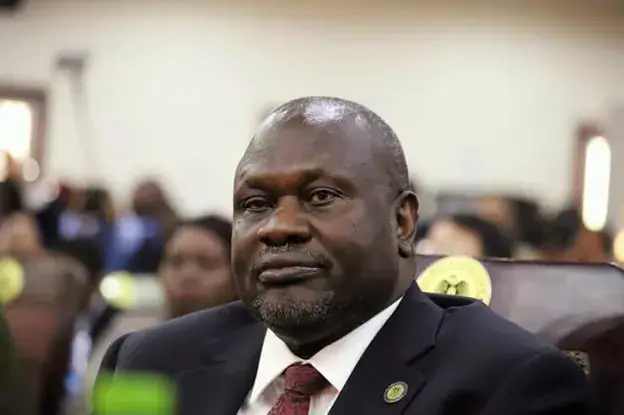
Former First Vice President Riek Machar has denied allegations linking him to the formation of the White Army. During his defense testimony, Machar stated that the group is not a standing military force and lacks the organizational structures required for him to command it. He made these statements in the 124th session of the trial. Machar is the fifth accused in the case. His testimony was given on Monday.
Machar noted that responsibility for the group's formation had been attributed to him by Hon. Kuol Manyang. Kuol Manyang linked the White Army's origins to the Nasir Declaration of August 28, 1991. Machar acknowledged that during the 1991 Sudan People's Liberation Movement/Army (SPLM/A) split, a Nuer spiritual leader, Wur Nyang Gatkech from Fangak, mobilized a group known as Nyaburjuk. This group participated in fighting against the Sudanese Army.
According to Machar, the Nyaburjuk group participated in an attack on Malakal. He described this as part of the struggle for liberation. Machar added that many of those involved in the fighting at the time are now elderly, with some in their seventies. The attack on Malakal was one of several battles fought by the group. Machar's testimony highlighted the historical context of the White Army.
Machar challenged the suggestion that armed civilian groups were exclusive to Nuer communities. He cited other groups that existed in areas controlled by the SPLM/A during the conflict. Examples include the Red Belt in Bor and the Arrow Boys in Western Equatoria. Machar argued that these groups demonstrate that armed civilians are not unique to Nuer areas.
Machar also denied that the White Army was sponsored by the Sudan People's Liberation Army in Opposition (SPLA-IO). He compared it to groups he identified as Dut Ku Beny, Mathiang Anyor, and Tit Bay. These groups, he alleged, were militias sponsored by the South Sudan People's Defence Forces (SSPDF). Machar drew comparisons between the White Army and traditional youth groups among other South Sudanese communities.
Machar described the White Army's members as traditional African village warriors. He noted that their access to modern small arms has increased over time. Machar argued that the group should not be classified as a militia due to its lack of organizational structures. The court adjourned the session to Wednesday, October 28, 2026, for Machar to continue his defense statement.
The trial of Former First Vice President Riek Machar continues. Machar's defense testimony is ongoing. The court will hear more of his statement on Wednesday. The case involves allegations linking Machar to the formation of the White Army. Machar's testimony has provided new insights into the group's origins and structure.
Key points
- Machar denies allegations of forming the White Army.
- The White Army lacks a military command structure, according to Machar.
- Machar's testimony highlights the historical context of the White Army.