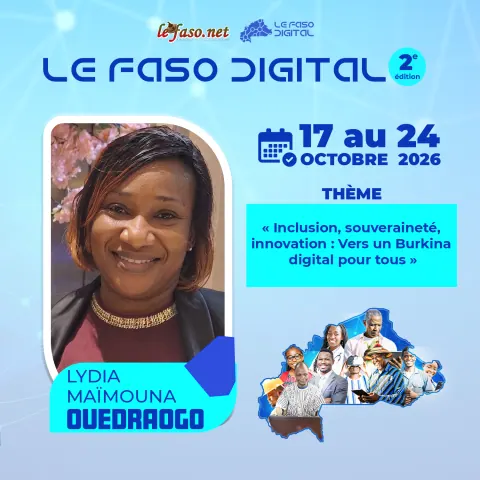
Lydia Maïmouna Ouédraogo Sénémé, an administrator of technologies for development at UNICEF Burkina Faso, has spent over two decades working at the intersection of technology and development. Her work focuses on using technology to address fundamental challenges, such as ensuring every child has an official identity, providing students with access to education, and enabling patients to access healthcare services. With a career spanning multiple sectors, Ouédraogo Sénémé has become a leading figure in Burkina Faso's digital transformation.
Ouédraogo Sénémé's journey began in Bobo-Dioulasso, where she studied at the Université polytechnique de Bobo-Dioulasso and the École supérieure des sciences appliquées between 1999 and 2002. She obtained a diploma in computer analysis and programming, as well as a DTS in computer management. Her early career was marked by a focus on traditional computer science, including software, applications, and database management.
In 2004, Ouédraogo Sénémé joined the Ministry of Justice and Human Rights, where she worked as head of the IT department at the Cour de cassation du Burkina Faso. During her nine-year tenure, she developed the institution's ICT strategy, created and interconnected local networks, and established a digital database of jurisprudence. Her work also involved exploring the use of technology in electoral processes.
In 2013, Ouédraogo Sénémé moved to the Ministry of Territorial Administration and Internal Security, where she played a key role in implementing a national biometric enrollment system for identity documents. The project achieved 100% coverage of communes across the country. She also worked on digitalizing the issuance of national identity cards and provided training in provinces and regions.
As Director of Regulation, Normalization, and Dematerialization of Procedures at the Ministry of Digital Economy and Posts, Ouédraogo Sénémé focused on establishing national ICT standards and guidelines for interoperability, quality, security, and information system architecture. Her work involved collaborating with various ministerial departments to develop sectoral digital transformation strategies and dematerialize public services.
Ouédraogo Sénémé is credited with contributing to the development of the Agrement Technique Informatique (ATI), a tool aimed at structuring and professionalizing Burkina Faso's digital sector. The ATI has become a reference for the industry, promoting local competence and enhancing the quality of digital services.
With her extensive experience and dedication to harnessing technology for development, Lydia Maïmouna Ouédraogo Sénémé has become a prominent figure in Burkina Faso's digital landscape. Her work continues to inspire and shape the country's digital transformation, with a focus on improving the lives of citizens through innovative uses of technology.
Key points
- Lydia Maïmouna Ouédraogo Sénémé has worked in various sectors, including justice, administration, and digital economy, to promote technology for development in Burkina Faso.
- She has played a key role in implementing national biometric enrollment and digital identity systems, achieving 100% coverage of communes across the country.
- Ouédraogo Sénémé has contributed to the development of national ICT standards and guidelines, promoting interoperability, quality, and security in the digital sector.