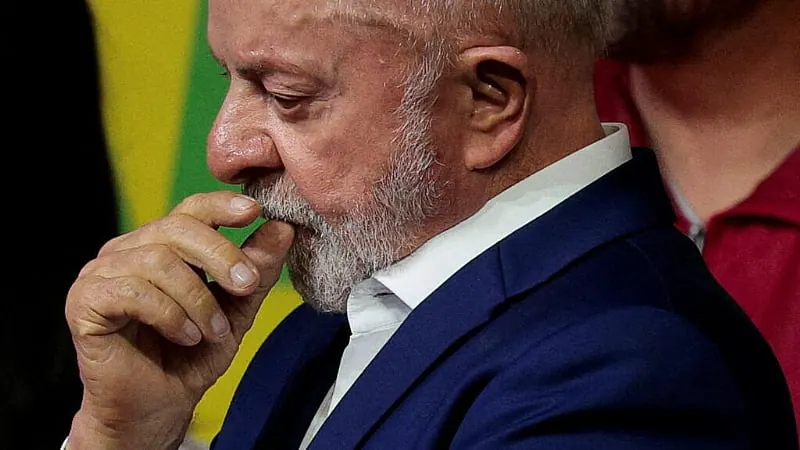
Brazilian President Luiz Inacio Lula da Silva's bid for re-election has been dealt a blow after he narrowly trailed far-right Senator Flavio Bolsonaro in the first round of the presidential election. Lula, a veteran left-wing leader and former trade unionist, secured a significant following among Brazil's poorest communities and organised working class during his previous two terms in office from 2003 to 2011. However, his centre-left Workers' Party (PT) now faces a significant challenge in mobilising support for the October 25 run-off.
The election results have been seen as a shock to Lula's supporters, with opinion polls having put him ahead of his rival in the days leading up to the vote. Flavio Bolsonaro, the eldest son of Jair Bolsonaro, who is serving a 27-year sentence for plotting a coup d'état, has promised a pardon for his father if he emerges triumphant in the second round. The younger Bolsonaro has maintained his father's appeal to voters frustrated by the status quo, according to Thomas Zicman de Barros, a fellow at the centre for political research at Sciences Po university in Paris.
Despite Lula's legacy of social-democratic policies that have lifted tens of millions of people out of poverty, he seems to have struggled to mobilise his base in the face of a far right that has succeeded in welding together a coalition of the country's business elite and rising lower-middle classes. Zicman de Barros noted that Lula, despite his trade union background and populist appeal, now embodies the establishment, while Flavio Bolsonaro and his family have been able to tap into an anti-establishment feeling.
The economic situation in Brazil has been a significant factor in the election, with the global cost-of-living crisis and mounting levels of household debt eating into the gains made under Lula's previous terms in office. Felipe Krause, a former Brazilian diplomat and the head of Oxford University's Brazilian Studies Programme, said that while unemployment is relatively low and income is rising, prices are high, and there is a lack of hope for prosperity in the future.
Krause noted that Lula's camp has not fully appreciated the changes in the country since his first two terms, including the rise of a new middle class that is more interested in entrepreneurialism and a pro-market individualistic approach. This shift has made it challenging for Lula's camp to offer the social protections and formal employment that they are used to providing.
The far-right Liberal Party (PL) is likely to emerge as the leading force in the lower-house Chamber of Deputies and the Senate, according to projections. Zicman de Barros said that Bolsonaro's campaign pledge to lower taxes and reduce bureaucracy may have resonated with many people in Brazil's lower-middle classes who are juggling multiple jobs in an expanding gig economy.
The election outcome has significant implications for Brazil's future, with the country of over 214 million people facing a choice between Lula's centre-left policies and Bolsonaro's far-right ideology. The second round of the presidential election will determine who will lead Brazil over the next four years.
Key points
- Lula's centre-left Workers' Party (PT) faces a significant challenge in mobilising support for the October 25 run-off.
- Flavio Bolsonaro has promised a pardon for his father, Jair Bolsonaro, if he emerges triumphant in the second round.
- The far-right Liberal Party (PL) is likely to emerge as the leading force in the lower-house Chamber of Deputies and the Senate.