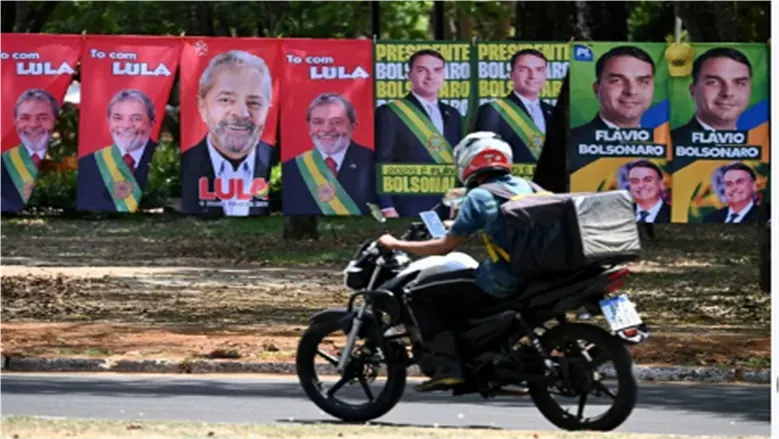
The Brazilian presidential election is heading for a runoff between incumbent President Luiz Inácio Lula da Silva and Senator Flávio Bolsonaro, after neither candidate secured a majority in the first round of voting. According to data from the electoral commission, Lula da Silva and Bolsonaro will compete in a second round of voting to determine the country's next president. This development was reported by Reuters and broadcast on the Cairo News Channel.
Lula da Silva, a veteran politician, has previously served as President of Brazil from 2003 to 2011. During his presidency, he implemented various policies aimed at reducing poverty and promoting economic growth. Bolsonaro, on the other hand, has been a prominent figure in Brazilian politics, serving as a senator and previously as a federal deputy. His campaign has focused on issues such as economic reform and law and order.
The Brazilian presidential election is a significant event in the country's politics, with implications for its economic and social development. The runoff election will be closely watched by observers, both domestically and internationally. The outcome will likely have a major impact on Brazil's relations with other countries, particularly in the region.
According to electoral data, Lula da Silva and Bolsonaro have significant support across the country. However, their campaigns have also been marked by controversy and polarization. The runoff election is expected to be closely contested, with both candidates vying for the support of undecided voters.
The runoff election is scheduled to take place on a date to be determined by the electoral commission. In the meantime, both candidates are expected to intensify their campaigns, engaging with voters and outlining their policy proposals. The election is likely to be closely monitored by international observers, who will assess the integrity and transparency of the process.
Lula da Silva and Bolsonaro have distinct policy agendas, which will likely be a key factor in the runoff election. Lula da Silva has emphasized the need for continued economic growth and social development, while Bolsonaro has focused on issues such as security and economic reform. The outcome of the election will likely reflect the priorities and values of the Brazilian electorate.
The Brazilian presidential election has significant implications for the country's future, both domestically and internationally. The runoff election between Lula da Silva and Bolsonaro will be a critical moment in the country's politics, determining the course of its development for the next few years.
Key points
- The Brazilian presidential election is headed for a runoff between Lula da Silva and Bolsonaro.
- Lula da Silva and Bolsonaro have significant support across the country.
- The runoff election is expected to be closely contested.