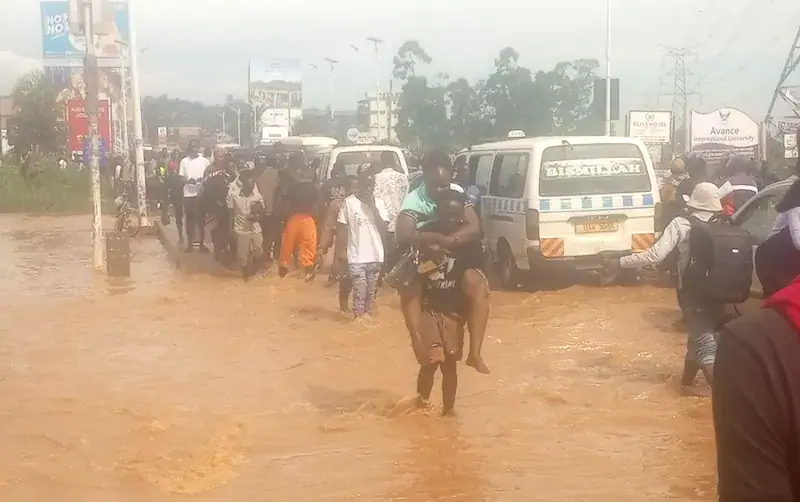
Heavy flooding at Lubigi bridge on Monday brought traffic along the Kampala-Hoima road to a standstill, stranding hundreds of motorists. The flooding followed an early morning downpour, with water levels continuing to rise and cutting off movement along the major transport corridor. Motorists travelling between Kampala, Wakiso, Nansana and Nabweru struggled to cross as traffic built up for several kilometres on either side of the bridge.
With vehicles unable to cross, some youths in Lubigi turned the flooding into an opportunity to earn money by carrying stranded pedestrians across the submerged section on their backs and shoulders. Most of those seeking the service were elderly people, women and commuters who feared navigating the deep, fast-moving water on foot. This impromptu service was charged at Shs 1,000 per person, with larger individuals paying Shs 2,000.
Ben Kato, a mechanic in Lubigi, said he had temporarily abandoned his garage to make money helping people cross the flooded section. He started the business at about 6:00am and had already collected approximately Shs 30,000. Kato noted that several people, mostly boda boda riders who insist on crossing while riding, have been falling in. His colleague, Moses Waiswa, said the flooding had become an unexpected source of income after they were evicted from vending along the Northern Bypass.
Joseph Musoke, a market vendor in Kasubi who was heading to work, was among those carried across the flooded section. He called for government intervention to redesign the bridge and address the recurring flooding. Musoke criticised the people who designed the Lubigi bridge, suggesting they should be held accountable for the problems caused by the flooding.
Jonathan Tusingwire, a taxi driver operating along Hoima road, said motorists had been stranded since 8:00am, with no immediate indication of when traffic would resume. He expressed concerns about the risks of crossing the flooded section, which could cause problems to the vehicle and result in losses. Tusingwire's situation highlights the challenges faced by motorists and commuters due to the flooding.
Wakiso district leaders, including Nansana Municipality MP Zambali Burasio Mukasa, have attributed the recurring flooding at Lubigi to poor wetland governance, selective enforcement of environmental regulations and alleged land allocations within the wetland. District engineers, led by Samuel Mwesigya, have called on the ministry of Works and Transport to redesign Lubigi Bridge along the Kampala-Hoima road to increase its capacity to accommodate larger volumes of water.
The latest incident has once again exposed the vulnerability of the Kampala-Hoima road to flooding, with commuters and motorists facing repeated disruptions whenever heavy rains hit the area. The flooding at Lubigi bridge highlights the need for a long-term solution to address the recurring problem and prevent future disruptions to traffic and economic activity.
Key points
- Flooding at Lubigi bridge was caused by poor wetland governance and environmental regulations.
- Recurring flooding at Lubigi bridge disrupts traffic and economic activity along the Kampala-Hoima road.
- District engineers recommend redesigning Lubigi Bridge to increase its capacity to accommodate larger volumes of water.