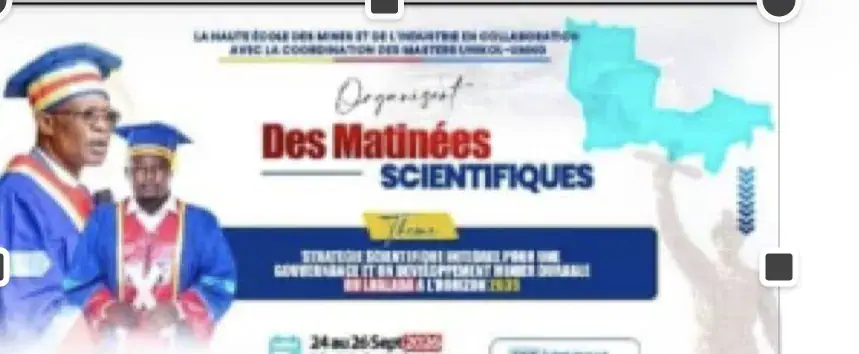
In the southeastern part of the Democratic Republic of Congo, the province of Lualaba is set to host a three-day scientific conference from September 24 to 26. The event, organized by the Higher School of Mines and Industries (HEMI), aims to discuss an integrated scientific strategy for sustainable mining governance and development by 2035. This initiative seeks to bring scientific research closer to the needs of governance, decision-making, and sustainable development in the mining sector.
On the first day of the conference, twelve research protocols from HEMI were presented. These protocols focus on various aspects, including sustainable financing for mining cooperatives, governance and traceability of metallurgical flows, hydrogeology and water resource management, stability of underground structures, and economic diversification in Lualaba. Additionally, the session covered environmental communication. According to environmentalist Pr Augustin Ngé Okwe, these diverse research projects share a common goal of better understanding, securing, optimizing, governing, and sustainably valorizing mineral resources for territorial development.
The research protocols presented constitute a scientific foundation for producing diagnostics, models, and decision-making tools. Furthermore, the new mining policy of the Democratic Republic of Congo, which aims to transition from an extractive economy to one that values mineral resources, was also introduced. This policy focuses on geological knowledge, local transformation, industrialization, local content, transparency, sustainability, and territorial development. The policy provides a strategic framework for transforming mineral resources into added value, jobs, and sustainable prosperity for the DRC and Lualaba.
Pr Augustin Ngé Okwe emphasized that the ambition of these scientific meetings is to bring research closer to the needs of governance, decision-making, and sustainable development in the mining sector. The conference provides a platform for stakeholders to discuss and address the challenges facing the mining industry in Lualaba and the DRC as a whole. By 2035, the goal is to have a well-defined strategy for sustainable mining governance and development in place.
The mining sector plays a crucial role in the economy of the Democratic Republic of Congo. However, the industry faces numerous challenges, including environmental degradation, social concerns, and economic disparities. The integrated scientific strategy discussed at the conference aims to address these challenges by promoting sustainable mining practices, improving governance, and ensuring that the benefits of mining are equitably distributed.
The conference also highlights the importance of collaboration between stakeholders, including government agencies, mining companies, local communities, and research institutions. By working together, these stakeholders can develop effective solutions to the challenges facing the mining sector and ensure that mineral resources contribute to sustainable development in Lualaba and the DRC.
The outcomes of the conference are expected to contribute to the development of a comprehensive strategy for sustainable mining governance and development in Lualaba by 2035. The strategy will provide a roadmap for stakeholders to follow, ensuring that the mining sector contributes to the well-being of local communities and the economy of the DRC as a whole.
Key points
- The conference aims to develop an integrated scientific strategy for sustainable mining governance and development in Lualaba by 2035.
- The strategy focuses on geological knowledge, local transformation, industrialization, local content, transparency, sustainability, and territorial development.
- The conference brings together stakeholders to discuss challenges and develop solutions for sustainable mining practices in the Democratic Republic of Congo.
Reporting sources
- Lualaba : la stratégie scientifique intégrée pour une gouvernance minière au centre d’une matinée · Congolese press agency