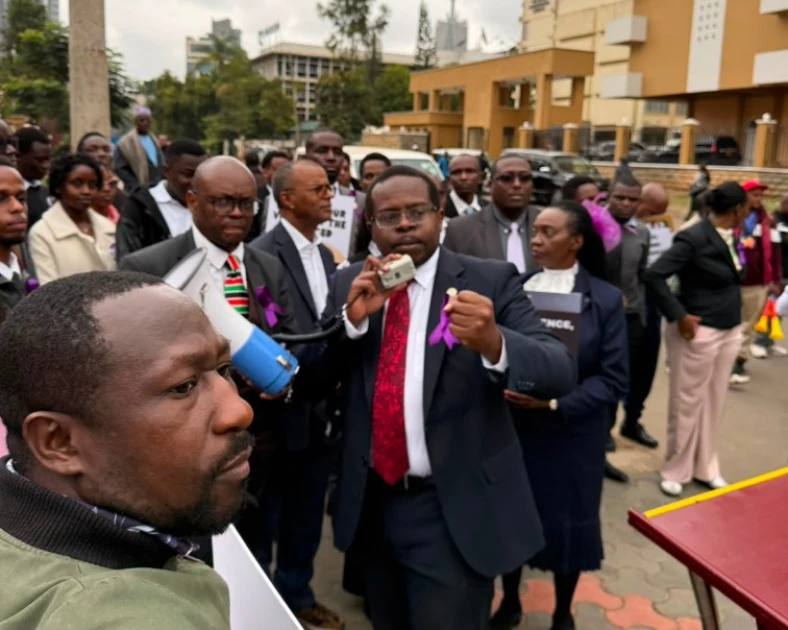
The Law Society of Kenya (LSK) has reinstated its directive for advocates to boycott certain courts and judicial officers, citing the Judicial Service Commission's (JSC) failure to fulfill several commitments. LSK President Charles Kanjama stated that the targeted boycott remains in force, with advocates directed to refrain from appearing before identified judges and judicial officers until further notice. This decision was made despite a July 31 engagement between the JSC, LSK Council, and Senior Counsel Bar, which resulted in an agreed framework on judicial performance reporting and complaints handling.
The agreed framework included measures such as judicial performance reporting, complaints handling, pending petitions, court-station integrity committees, and disciplinary regulations. However, LSK expressed concern that the JSC has not yet formally constituted and convened a Joint Committee established under the framework. The Society also raised concerns over the Judiciary's failure to publish institutional and court-level judicial performance reports within the agreed 30-day period.
LSK further noted that it has not received confirmation on the operationalization of an enhanced electronic system for lodging and tracking complaints. The Society continues to seek updates on pending petitions and complaints before the JSC. Other outstanding issues include the provision of contact details for court-station Integrity Committees and the latest draft of the Judicial Service Commission Disciplinary Process Regulations.
The targeted boycott list issued by LSK includes several high-profile judges, including Deputy Chief Justice Philomena Mwilu, Justice Anthony Ombwayo, and Justice Lucas Naikuni. The list also names Supreme Court judges Chief Justice Martha Koome, Justice Isaac Lenaola, and Justice Smokin Wanjala, among others. LSK stated that the boycott will continue indefinitely until further communication.
The boycott was initially announced after a nationwide one-day court boycott on July 22, prompted by concerns over delays in case hearings and determinations, court registry operations, and mechanisms for addressing complaints against judges and judicial officers. LSK President Charles Kanjama stated that advocates continue to experience delays and inefficiencies in court registries.
JSC Chairperson Martha Koome previously criticized the boycott, warning that it disrupts court proceedings, delays justice, and denies Kenyans their constitutional right to have cases heard without unnecessary delay. Koome emphasized that concerns about judicial conduct should be addressed through mechanisms provided under the Constitution and the Judicial Service Act.
Despite the boycott, LSK stated that it will continue engaging with the JSC and Judiciary through the proposed Joint Committee. The Society emphasized that the boycott does not end its institutional engagement with the JSC and Judiciary as it seeks implementation of the resolutions reached in July.
Key points
- The Law Society of Kenya has renewed its targeted court boycott, citing unfulfilled commitments by the Judicial Service Commission.
- The boycott includes several high-profile judges and will continue indefinitely until further communication.
- LSK will continue engaging with the JSC and Judiciary through a proposed Joint Committee despite the boycott.