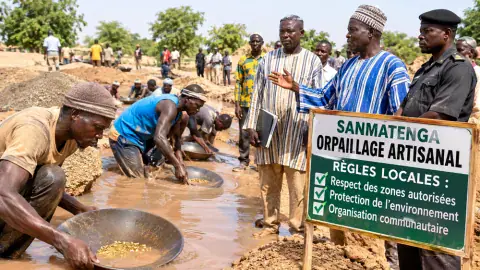
Artisanal gold mining has become a vital economic activity in rural Burkina Faso, particularly in the Sanmatenga province. The boom in gold mining is attributed to a combination of local factors, including agricultural vulnerability and rural poverty, as well as the international context of rising gold prices. However, the expansion of artisanal mining has occurred in a context of liberalized mining policies, leading to a decline in state control and a lack of effective regulation.
The limited state control has resulted in a regulatory vacuum, leading to conflicts over land use and environmental degradation in mining areas. The absence of clear regulations has also led to the emergence of informal and private dynamics, which have further complicated the relationships between artisanal mining and other economic activities in the region. In response to this situation, local mechanisms for regulating artisanal gold mining have begun to emerge in the Sanmatenga province.
A study conducted in 2019 by researchers from the Institut des Sciences des Sociétés (INSS/CNRST) examined the local governance of artisanal gold mining in the Sanmatenga province. The study used a qualitative and participatory approach, involving semi-structured interviews with key stakeholders, including administrative representatives, customary authorities, and artisanal miners. The researchers also conducted focus groups with miners and observed mining activities on the ground.
The study found that local rules and customary authorities play a crucial role in regulating artisanal gold mining in the Sanmatenga province. The Tengsoba, or customary authorities, have established their own rules and regulations to govern mining activities, including the use of mercury and the rehabilitation of mined lands. These local rules have helped to mitigate some of the negative socio-economic and environmental impacts of artisanal mining.
However, the study also highlighted the limitations of local regulation in addressing the complex challenges posed by artisanal gold mining. The researchers noted that local rules and regulations are often fragmented and lack coordination, which can lead to inconsistent enforcement and uneven impacts on different communities. Furthermore, the study found that local regulation is not a substitute for effective state control and that a more comprehensive approach is needed to address the challenges posed by artisanal gold mining.
The emergence of local rules and regulations in the Sanmatenga province reflects a broader trend in Burkina Faso, where decentralization and limited state capacity have created space for local actors to take control of regulating artisanal gold mining. While local regulation has helped to mitigate some of the negative impacts of mining, it also raises questions about the role of the state in regulating this activity and ensuring that it contributes to sustainable development.
The study's findings have important implications for policymakers and stakeholders seeking to improve the governance of artisanal gold mining in Burkina Faso and other countries. The researchers argue that a more nuanced understanding of local dynamics and the role of customary authorities is needed to develop effective regulatory frameworks that balance the needs of different stakeholders. Ultimately, the study highlights the need for a more comprehensive approach to regulating artisanal gold mining that takes into account the complex social, economic, and environmental impacts of this activity.
Key points
- Local rules and customary authorities play a crucial role in regulating artisanal gold mining in Burkina Faso's Sanmatenga province.