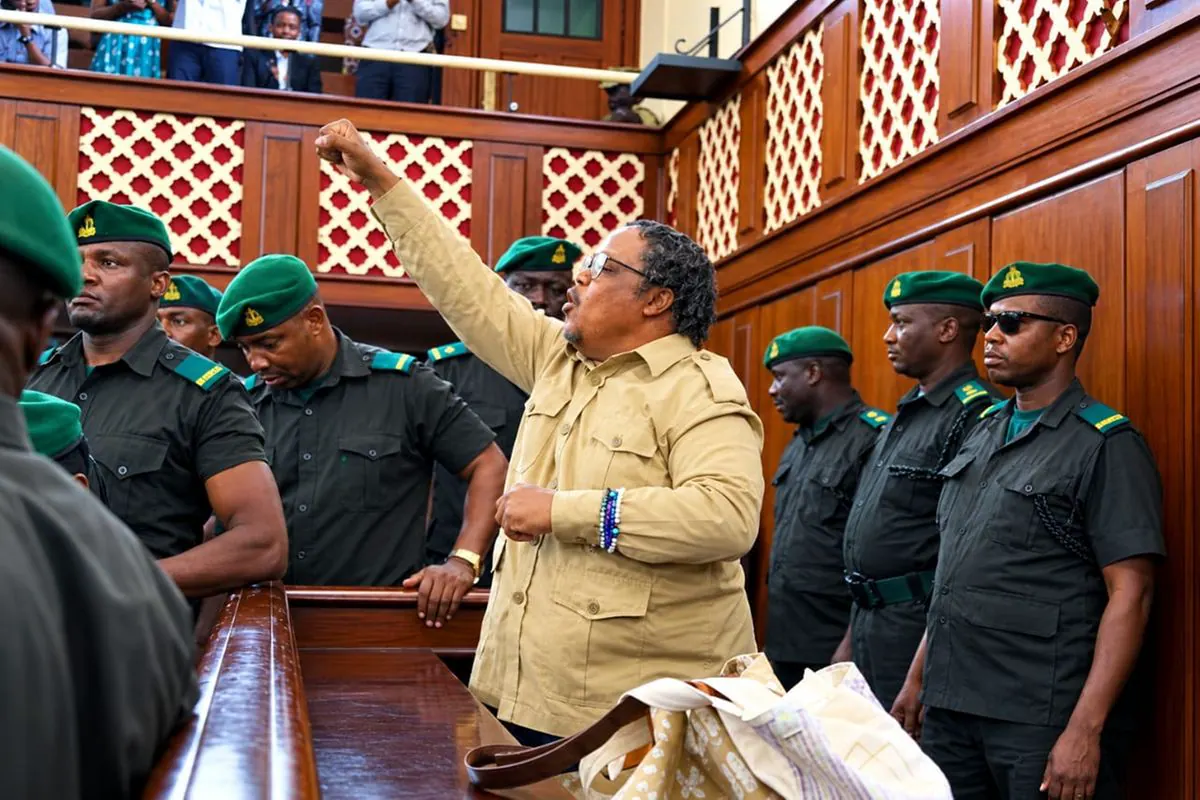
Chadema national chairman, Tundu Lissu, has told the High Court in Dar es Salaam that the treason case against him is based on speculation. He argued that the prosecution has failed to establish a legal basis for the charge. Lissu made these submissions before Justices Dunstan Ndunguru, James Karayemaha, and Ferdinand Kiwonde as he continued his final arguments. He faces a treason charge under Section 39(2)(d) of the Penal Code.
Lissu identified nine issues for the court to determine, including a legal defect in the charge sheet. He argued that Section 39(2)(d) does not criminalise an intention to mobilise 'the public', but refers to 'a person or group of people', making the wording too broad to give him adequate notice. Lissu submitted that he has been prosecuted because of speculation and that the law does not permit speculative charges.
Lissu challenged the prosecution's interpretation that threatening to disrupt an election necessarily amounts to threatening the government. He attributed this reasoning to Senior Assistant Commissioner of Police, ACP George Bagyem. Lissu cited laws administered by different constitutional bodies, including legislation governing the Judiciary and Parliament. He argued that electoral matters fall under the Electoral Commission rather than the Executive.
Lissu noted that treason is the only constitutional offence punishable by death. He stated that the prosecution wants him hanged simply on speculation that he threatened the government. Lissu cited judicial precedents, arguing that criminal guilt cannot be established through speculation. He prayed that the court does not accept the prosecution's call to sentence him to death.
Lissu examined the prosecution evidence, stating that only four of the 17 witnesses addressed the incitement allegation. He argued that the three police officers were not at the meeting and relied on online material. Lissu highlighted that the 17th prosecution witness, an undercover civilian journalist, was the only eyewitness who saw and heard him at the meeting.
Lissu said the 17th witness confirmed that the meeting was held to explain Chadema's "No reforms, no election" position to election aspirants. During cross-examination, the witness acknowledged that he had seen nothing treasonous and did not consider Lissu's words an offence. Lissu declared that the witness is not his witness but a witness for those who want to see him sentenced to hang.
Lissu further argued that his defence testimony showed that his remarks were intended to encourage aspirants to boycott the election until democratic reforms were achieved, rather than incite violence. He said the prosecution did not cross-examine him on his intention or the meeting's purpose. Lissu cited Court of Appeal decisions, arguing that failure to cross-examine a witness on a material point amounts to acceptance of that evidence.
Key points
- Lissu claims the treason case against him is based on speculation.
- Lissu argues that the prosecution has failed to establish a legal basis for the charge.
- Lissu faces a treason charge punishable by death.