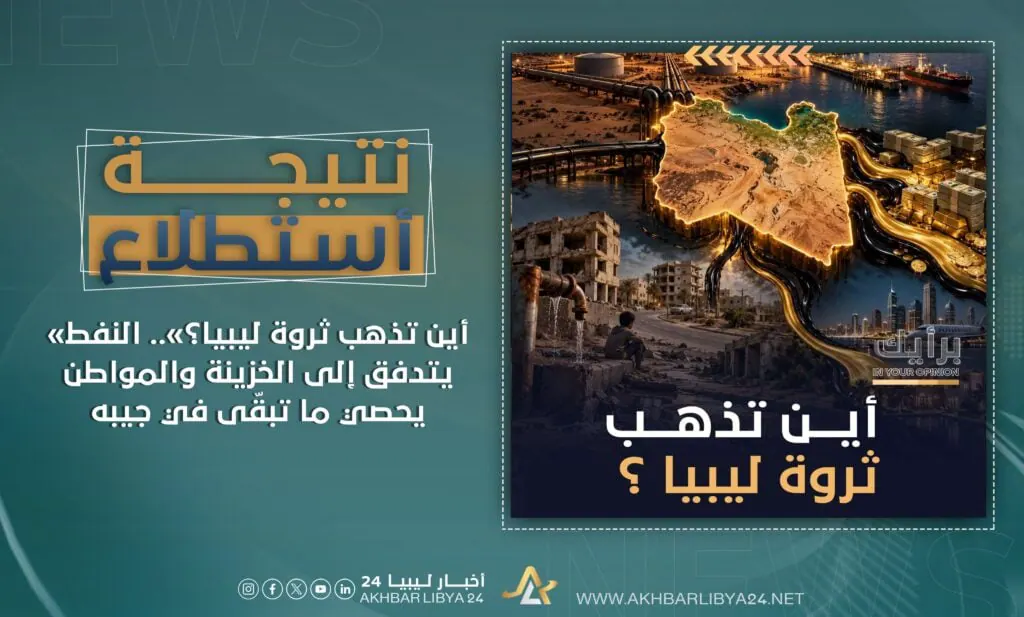
Libyans are questioning where their country's vast oil wealth is going, as they struggle with high living costs and poor public services. Despite being a major oil producer, many Libyans are unable to afford basic necessities like food, healthcare, and education. A recent survey by Akhbar Libya 24 found that citizens are frustrated with the lack of transparency in government spending and the failure of public institutions to provide essential services.
The survey, which was conducted in several Libyan cities, found that citizens are concerned about the large gap between the country's oil revenues and the standard of living. Many Libyans are asking why they are not seeing the benefits of their country's oil wealth in their daily lives. They want to know why they have to struggle to make ends meet, while the government claims to be earning billions of dollars from oil exports.
According to the Central Bank of Libya, the country's total public revenues reached around 136.5 billion dinars in 2025, while public spending was around 136.8 billion dinars. Oil revenues accounted for 99.6 billion dinars, while fuel subsidies totaled 34.5 billion dinars. However, many Libyans are skeptical about the government's claims of high revenues, and are demanding more transparency in public spending.
The Libyan government has been criticized for its lack of transparency in public spending, and for failing to provide essential services like healthcare, education, and electricity. Many Libyans are frustrated with the frequent power outages, fuel shortages, and lack of access to basic services. They are also concerned about corruption and mismanagement of public funds.
The International Monetary Fund (IMF) has warned that Libya's economy is facing significant challenges, including high inflation and a decline in purchasing power. The IMF has called for improved governance and institutional reforms to promote economic growth and stability. Libyans are demanding that the government take concrete steps to address these issues and provide better services.
One of the main challenges facing the Libyan government is the need to diversify the economy and reduce its dependence on oil exports. The country's economy has been heavily reliant on oil revenues for decades, but this has made it vulnerable to fluctuations in global oil prices. Libyans are calling for the government to invest in other sectors, such as agriculture, manufacturing, and tourism, to create jobs and stimulate economic growth.
Libyans are also demanding that the government take steps to address corruption and mismanagement of public funds. They want to see more transparency in public spending, and for the government to be held accountable for its actions. Ultimately, Libyans want to see the benefits of their country's oil wealth in their daily lives, and are calling for the government to take concrete steps to improve their standard of living.
Key points
- Libyans are questioning where their country's vast oil wealth is going, as they struggle with high living costs and poor public services.
- The Libyan government has been criticized for its lack of transparency in public spending, and for failing to provide essential services like healthcare, education, and electricity.
- Libyans are demanding that the government take concrete steps to address corruption, mismanage public funds and provide better services.