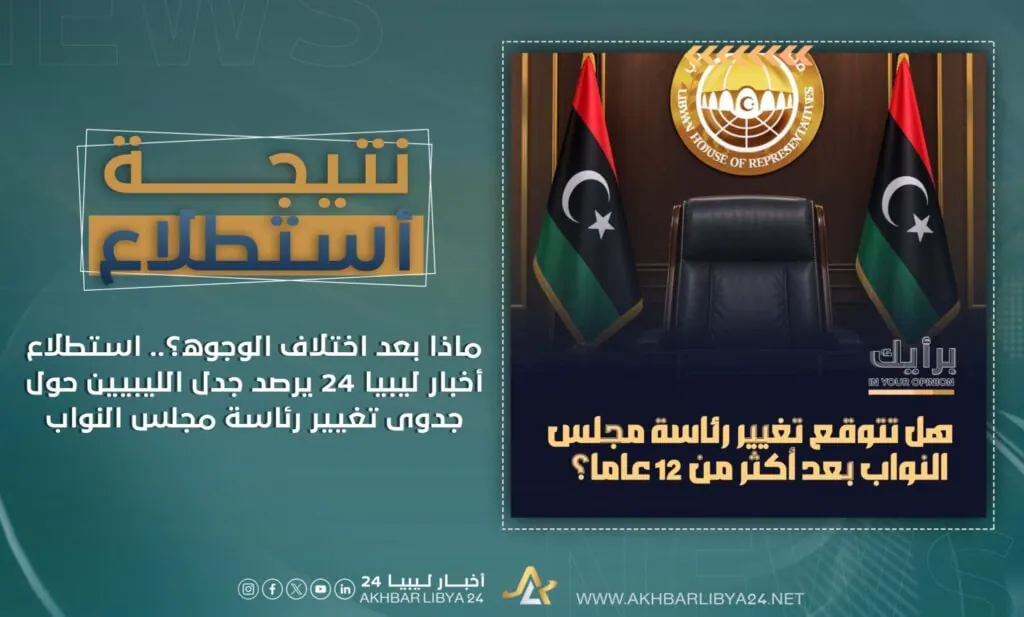
Libyans are divided over whether changing the leadership of the parliament would help end the country's political stalemate. A recent survey by Akhbar Libya 24 found that some citizens believe a change in leadership is necessary, while others think it would not be enough to resolve the crisis. The debate comes as the country continues to struggle with a transitional phase that has lasted over 12 years. The survey asked participants if they expected a change in the leadership of the parliament.
Some participants in the survey argued that a change in leadership is not enough to solve the problem, as the issue is more deeply rooted in the country's institutions and transitional phase. One citizen commented that the problem is not with the change itself, but with who would replace the current leadership. This view reflects a concern that a change in leadership would not necessarily lead to a change in the country's fortunes. The transitional phase has been marked by continued instability and delays in holding elections.
Others who participated in the survey were more critical of the current leadership, arguing that a change was long overdue. One citizen wrote that the current leadership has outstayed its welcome and that it is time for a change. Another participant suggested that a new leadership could pave the way for fresh elections and a more stable future. The survey reflects a wider debate in Libya about the need for change and reform.
The survey also highlighted concerns about the accountability of those in power. One participant suggested that any new leadership should be held accountable for their actions and that those who have obstructed progress in the past should face justice. This view reflects a desire for greater transparency and accountability in the country's governance. The issue of accountability has been a major concern in Libya's transitional phase.
The debate over changing the leadership of the parliament comes as the international community continues to push for a peaceful resolution to the crisis. The United Nations has been working to support a political process that would lead to fresh elections and a more stable future for Libya. A recent agreement signed in August 2026 aimed to unify the country's institutions and pave the way for elections.
However, some participants in the survey were skeptical about the prospects for change, arguing that the problem is more deeply ingrained than a simple change of leadership. One citizen commented that the country's problems will not be solved by changing one person or institution, but rather by a more fundamental transformation of the country's politics and institutions. This view reflects a concern that the country's problems run deeper than a simple change of leadership.
The survey by Akhbar Libya 24 reflects a wider debate in Libya about the need for change and reform. While there are different views on the best way forward, there is a general recognition that the country's transitional phase has lasted too long and that a change is needed. The country's future will depend on the ability of its leaders to work towards a more stable and prosperous future.
Key points
- The debate over changing the leadership of the parliament reflects a wider discussion in Libya about the need for reform and change.