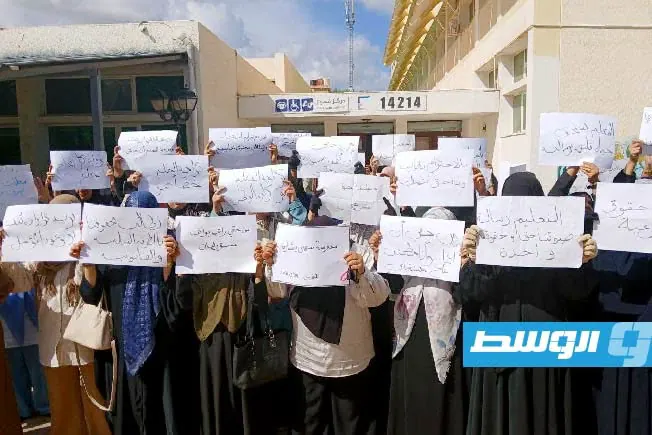
The Libyan Teachers' Union has reaffirmed its commitment to demands for improved working conditions, including a unified and fair salary scale, and the payment of delayed benefits and financial differences. The union's stance was reiterated during a meeting between the General Committee of Teachers and the local committees of Zawiya and Sorman.
The union's General Secretary, Ramadan Hamum, emphasized that the union will not back down from its demands, stressing that the current actions, including strikes and sit-ins, will continue until the demands are met. He clarified that the union's movement does not aim to overthrow the government or the Minister of Education but rather seeks to claim the rights of teachers.
A key demand of the union is the adoption of a unified salary scale that considers the job grade, academic qualification, and years of experience, reducing existing disparities between employees in various state sectors. The union's spokesman, Ashraf Aburawi, highlighted that the rising cost of living and declining purchasing power of salaries have prompted teachers to demand a review of their wages.
Aburawi pointed out that some sectors still receive salaries at the same levels as years ago, and the demand for a unified salary scale is a top priority for teachers, along with the payment of delayed benefits, including the allowance for hours worked and differences. He stressed that the new salary scale should consider job grades, qualifications, and experience.
The issue of financial differences is of particular importance to teachers, with Hamum stating that there are entitlements related to the salary scale and financial differences dating back to 2023. He called for the implementation of these entitlements, emphasizing that they should not be treated as unclear or unjustified demands.
The Libyan professional unions have also entered the crisis, calling on the government to initiate a national dialogue within 48 hours to address economic reforms that achieve social justice and stop the erosion of workers' income. The unions warned of escalating measures if their demands are not met within the specified timeframe, including a general strike and open-ended labor protests.
The ongoing teacher protests have raised concerns about the impact on the academic year in Libya, with fears that delayed studies and accumulated curricula may affect students. However, Aburawi noted that the Libyan education sector has previously dealt with circumstances that led to delays in study and suggested that adjustments to study schedules or reorganization of curricula could make up for lost time.
Key points
- The Libyan Teachers' Union demands a unified salary scale and payment of delayed financial benefits.
- The union's actions, including strikes and sit-ins, will continue until demands are met.
- Libyan professional unions have called for a national dialogue with the government to address economic reforms.