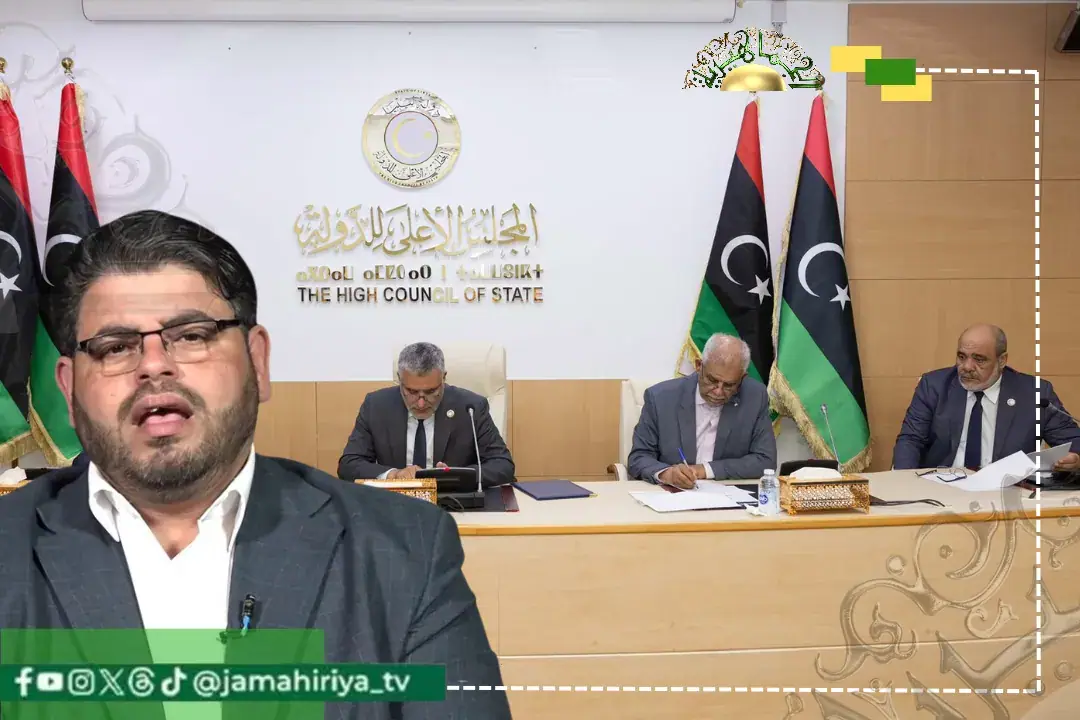
Libyan political analyst Abdullah Al-Dibani has attributed the rejection of the 4+4 committee's outcomes by some parties to their fear of losing influence and control over the country's political decision-making process. In statements reported by the Russian news agency Sputnik, Al-Dibani noted that the renewed debate in Libya's political scene on mechanisms for a political solution coincides with the United Nations' efforts to convert understandings into concrete steps.
Al-Dibani stated that the objections raised by some parties do not necessarily reflect a setback in the UN approach but rather reveal resistance from those who benefit from the current situation. He described the UN-led process, which resulted in the formation of the 4+4 committee and agreement on addressing electoral laws, reconstituting the election commission, and unifying the executive authority, as a significant breakthrough in the political stalemate.
The analyst noted that this process provides an international framework to end the deadlock and exit the cycle of successive transitional phases. Al-Dibani emphasized that the objections from some political committees and existing bodies regarding the 4+4 committee's outcomes and the UN mission are linked to concerns about losing their influence and control over legislative and political decision-making.
These parties, according to Al-Dibani, have maintained their grip on power for years without achieving elections or allowing the people to decide through ballot boxes. They base their reservations on rejecting what they describe as parallel tracks or mini-agreements, which they believe undermine their constitutional powers.
Al-Dibani pointed out that the failure of traditional consensus between the House of Representatives and the State Council was one of the main reasons the UN mission sought more flexible negotiation formulas, including influential parties to ensure the implementation of reached understandings. He believes the UN mission does not aim to bypass or exclude existing institutions but rather to stimulate and activate their role within a specific timeframe.
The analyst considered the referral of the 4+4 committee's agreement to the House of Representatives and the State Council for approval as a move by the UN mission to ensure institutional legitimacy. This agreement also includes mechanisms to transition to a broader national format if consensus between institutions proves impossible or if a state of obstruction continues.
Al-Dibani viewed the activation of the 4+4 committee's outcomes as one of the most realistic paths to resolving the Libyan crisis. He called for prioritizing national interest and unifying local and international efforts to pave the way for comprehensive presidential and legislative elections, ending the division and restoring the people's right to choose their authorities.
Key points
- The rejection of the 4+4 committee's outcomes by some Libyan parties is driven by fear of losing influence and control.
- The UN-led process aims to end the political stalemate and transition Libya to a more stable phase.
- The activation of the 4+4 committee's outcomes could be a key step towards resolving the Libyan crisis.