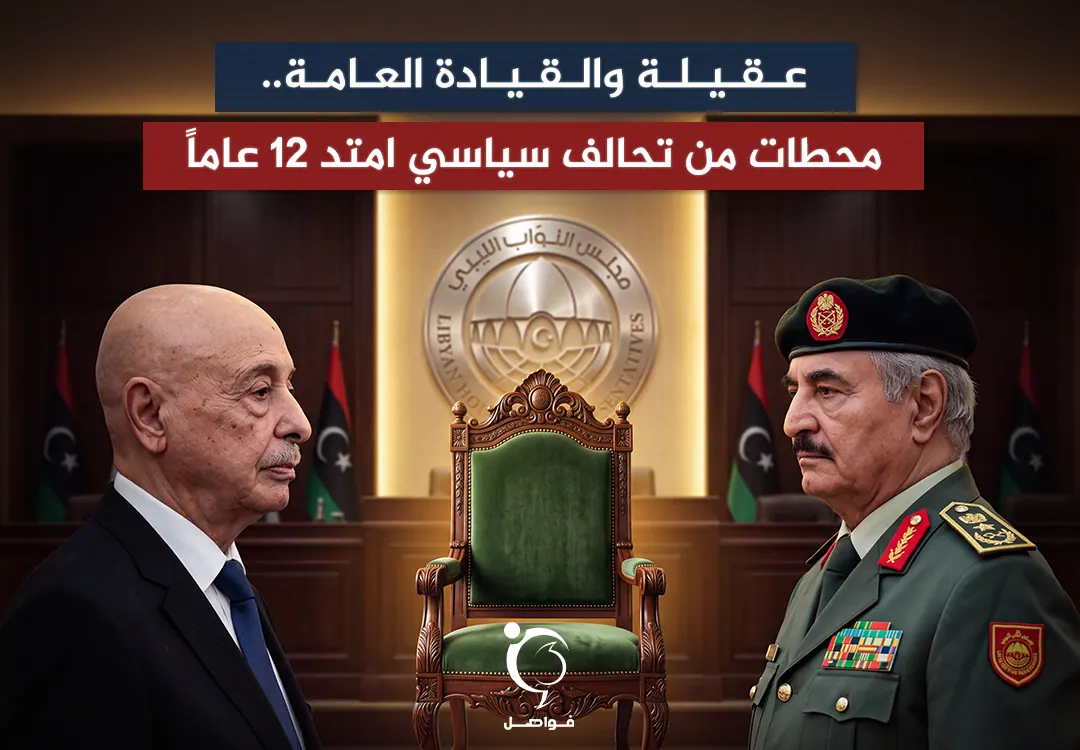
The Libyan House of Representatives has voted to adopt a 12-month parliamentary session, with 98 out of 102 attending members supporting the decision. A new leadership will be elected within seven days, effectively ending Aguila Saleh's term as head of the council. This move comes after Saleh's close ties with Khalifa Haftar and the General Command were scrutinized.
Aguila Saleh's relationship with the General Command began in August 2014, when he was first elected as the head of the Libyan parliament. Since then, his political and legislative path has been closely tied to Haftar and the General Command. One of the earliest significant moves was in March 2015, when the parliament approved Haftar's promotion to the rank of general and appointed him as the commander-in-chief of the army.
Saleh's tenure was marked by several key decisions that supported Haftar and the General Command. In 2016, he refused to grant confidence to the government of Fayez Serraj, citing concerns that the Skhirat agreement would undermine the military institution. The relationship between Saleh and the General Command continued to strengthen over the years, with the parliament approving several key decisions, including a 6 billion dinar loan to the government in 2022.
The Libyan parliament also passed a law in 2025, which approved the public debt of over 303 billion dinars. This move was seen as a significant step in addressing the country's financial challenges. Additionally, the parliament created a fund for the development and reconstruction of Libya, which was entrusted to Belqasim Haftar, and approved a law reorganizing the military hierarchy, creating a new position of deputy commander-in-chief, which was taken by Saddam Haftar.
The end of Saleh's term as head of the parliament marks a significant shift in the Libyan political landscape. According to sources, Haftar had expressed his support for the changes, meeting with around 70 members of parliament to discuss the need for consensus and amendments to the internal regulations. The new leadership will likely play a crucial role in shaping the country's future.
The relationship between Saleh and Haftar has been a defining feature of Libyan politics for over a decade. While their alliance has been instrumental in shaping the country's military and political landscape, it has also been subject to criticism. As the country moves forward, the new leadership will need to navigate these complex dynamics and address the challenges facing the nation.
The implications of this change in leadership are still unclear, but it is evident that the country is entering a new phase. The international community will be watching closely, as Libya continues to navigate its complex transition towards stability and democracy.
Key points
- The Libyan parliament has adopted a 12-month session and will elect a new leadership within seven days.
- Aguila Saleh's relationship with Khalifa Haftar and the General Command has been a defining feature of Libyan politics for over a decade.
- The new leadership will need to navigate complex dynamics and address the challenges facing the nation.