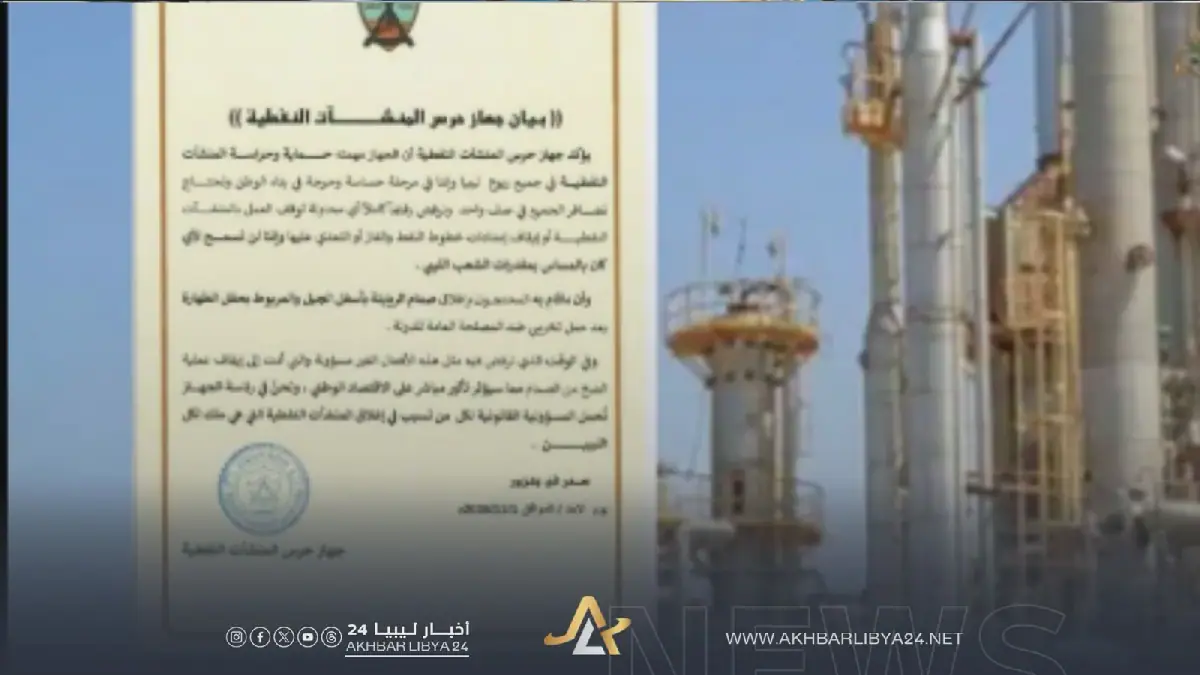
The Libyan National Oil Corporation's affiliated facility guard, under the Government of National Unity, has stated that protecting and securing oil and gas facilities and pipelines nationwide is its primary responsibility. The guard warned against attempts to disrupt operations or halt supplies, emphasizing that it will not allow the country's oil wealth, a key national economy component, to be compromised.
In a statement released on Sunday, the guard noted that Libya is going through a sensitive and critical phase in its state-building process, requiring concerted efforts and cooperation, away from actions that could harm national capabilities or disrupt vital institutions. The guard rejected any attempts to halt operations at oil facilities, disrupt oil and gas supplies, or damage them, citing the direct impact on the national economy and citizens' interests.
The facility guard emphasized that it will not allow any entity or party to compromise the Libyan people's resources, reiterating its commitment to protecting oil facilities and ensuring their continued operation, as they are national assets owned by all Libyans. Commenting on recent protests, the guard viewed the closure of the Riyayna valve, linked to the Al-Thahara field, as a destructive act against the state's public interest, disrupting oil flow and harming the energy sector.
The guard's stance comes amid escalating protest movements related to the closure of some facilities and oil transportation lines, raising concerns about supply continuity and its impact on production and oil revenues. The guard's leadership stated that it will hold fully accountable, under the law, anyone proven to be involved in closing or disrupting oil facilities, emphasizing that protecting these facilities is not only a security aspect but also related to safeguarding the rights of all Libyans to their national resources.
These developments occur as the Libyan oil sector faces repeated challenges due to protests and closures affecting fields and crude transportation lines, causing disruptions in supplies, production declines, and financial losses for the national economy. Prior instances of oil transportation line closures resulted in production losses, including the halt of supplies via Al-Thahara and Al-Hamada lines towards Zawiya, before reopening, with estimated losses of around 10,000 barrels per day during the closure period.
Libya primarily relies on oil revenues to finance public spending and provide foreign currency, making sustained production and export crucial for maintaining financial and economic stability. Any field or supply line closures carry repercussions that extend beyond the affected oil site to the entire economy. With recurring protests linked to living conditions and local disputes, the issue of using oil as leverage resurfaces, balancing protester demands with the risks of disrupting the state's primary resource.
The situation highlights the need for sustainable solutions that separate social and political demands from continued production and national wealth protection.
Key points
- The Libyan facility guard has warned against disrupting oil and gas supplies.
- Recent protests have led to the closure of oil facilities and transportation lines.
- The disruptions have resulted in production losses and financial impacts on Libya's economy.