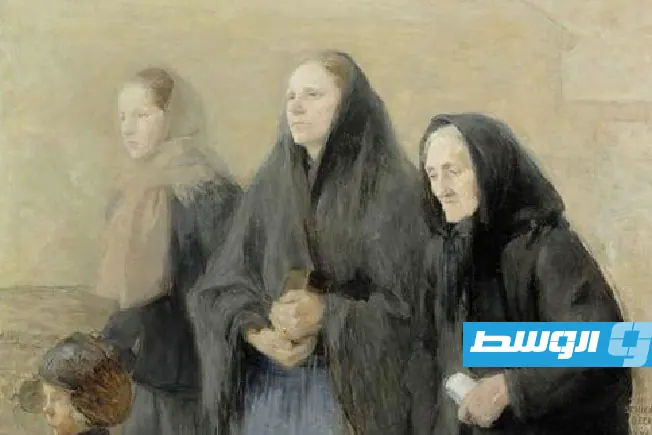
The Libyan media outlet Al-Wasat recently featured the work of Finnish artist Helene Schjerfbeck, who is known for her distinctive style and significant contributions to modern art. Born in 1862, Schjerfbeck studied fine arts in Paris and later in Sweden, where she developed her unique approach to art. Her work is characterized by simplicity, reduction, and a touch of irony, setting her apart from her contemporaries. Schjerfbeck's artistic style evolved over the years, influenced by various movements, including naturalism, realism, and expressionism.
Schjerfbeck's early work was marked by a realistic style, influenced by the French school and outdoor painting techniques. However, as she progressed in her career, her art took on a more abstract and expressive quality. Her subjects ranged from portraits and landscapes to still-life compositions. One of her notable works from this period is "The Wounded Warrior in the Snow" (1880), which showcases her ability to convey powerful emotions through her art. Schjerfbeck's innovative approach to art earned her a reputation as a pioneering female artist in a male-dominated field.
In 2026, the Metropolitan Museum of Art in New York hosted an exhibition titled "Seeing Silence: Paintings by Helene Schjerfbeck," which marked the first major retrospective of her work in a prominent American museum. The exhibition featured around 60 of her works, including pieces from the National Gallery of Finland (Ateneum Art Museum) and other Finnish museums, as well as private collections in Finland and Sweden. This exhibition highlighted Schjerfbeck's significance as a voice in the modern art movement and introduced her work to a wider audience.
Schjerfbeck's artistic development was influenced by her studies at the Drawing School of the Finnish Art Society and later at the Académie Colarossi in Paris. Her talent and dedication earned her the White Rose of Finland, a prestigious honor in her home country. Interestingly, the Finnish government designated July 10, Schjerfbeck's birthday, as a national day for visual arts, underscoring her lasting impact on Finnish art.
Throughout her long and productive career, Schjerfbeck's art underwent significant transformations, reflecting her experimentation with various styles and techniques. Her work continues to inspire artists and art enthusiasts alike, offering a unique perspective on the world. Al-Wasat's feature on Schjerfbeck serves as a testament to the enduring appeal of her art and the growing interest in modern art from around the world.
Schjerfbeck's legacy extends beyond her artistic contributions, as she paved the way for future generations of female artists. Her determination and perseverance in the face of adversity serve as an inspiration to artists and individuals alike. As the art world continues to evolve, Schjerfbeck's work remains a vital part of the modern art canon, offering insights into the human experience and the power of creativity.
The recognition of Schjerfbeck's work by Libyan media outlets like Al-Wasat highlights the global reach and relevance of her art. As the art world becomes increasingly interconnected, it is essential to acknowledge and celebrate the contributions of artists like Schjerfbeck, who have made significant impacts on the development of modern art. By sharing her story and work with a broader audience, Al-Wasat has helped to promote cross-cultural understanding and appreciation for the arts.
Key points
- The Libyan media outlet Al-Wasat recently featured the work of Finnish artist Helene Schjerfbeck.
- Schjerfbeck's artistic style evolved over the years, influenced by various movements, including naturalism, realism, and expressionism.
- The Finnish government designated July 10, Schjerfbeck's birthday, as a national day for visual arts.