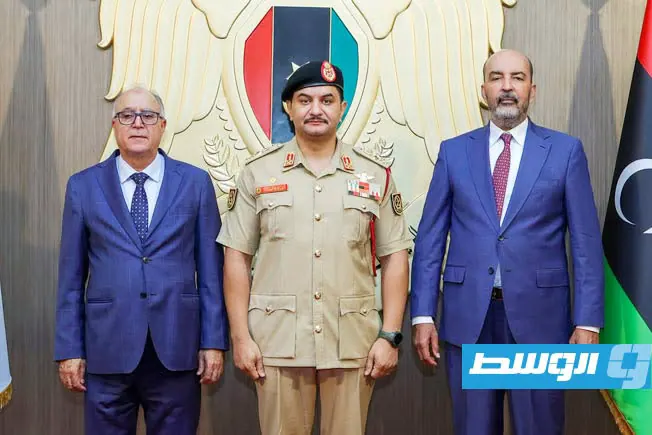
Libyan rival factions met on Sunday, October 11, 2026, to discuss unifying the country's institutions and ending the ongoing division. The meeting was held between Field Marshal Khalifa Haftar's deputy, Saddam Haftar, and the House of Representatives' Speaker, Saleh Abdul Nabi, and Presidential Council member, Mousa Al-Koni. The discussions focused on supporting efforts to unify the country's institutions and hold presidential and legislative elections.
The meeting took place at the General Command headquarters in Benghazi, where the parties discussed the latest developments in the country's political scene and ways to support efforts to unify institutions and end the division. According to a statement from the General Command's media office, the parties emphasized the importance of moving forward with holding presidential and legislative elections to achieve the Libyan people's aspirations for a unified and stable state.
Earlier on Sunday, Field Marshal Khalifa Haftar met with Saleh Abdul Nabi, and they discussed the latest political developments and efforts to support stability and end the division. The two leaders also discussed ways to unify the country's institutions. Saleh Abdul Nabi was elected as the House of Representatives' Speaker in a session held in Benghazi last Tuesday, which was boycotted by outgoing Speaker Aguila Saleh.
On Friday, Saleh Abdul Nabi met with Khalid Haftar, the Chief of Staff of the General Command's forces, in Benghazi. During the meeting, Khalid Haftar congratulated Abdul Nabi on his election as Speaker and wished him and his new leadership team success in their duties. The two leaders discussed the latest developments in the country and emphasized the importance of supporting efforts to enhance stability and unify institutions.
The meetings come as part of ongoing efforts to unify Libya's institutions and end the country's division. Libya has been plagued by instability and conflict since the 2011 uprising that overthrew Muammar Gaddafi. The country has had rival governments and institutions, with the Government of National Accord based in Tripoli and the General Command based in Benghazi.
The international community has been pushing for a peaceful resolution to the conflict and the holding of elections to establish a unified government. The United Nations has been working with Libyan parties to reach a peaceful solution and hold elections. The country's instability has also had a significant impact on its economy, with the Central Bank of Libya struggling to manage the country's finances.
The meetings between the rival factions are seen as a positive step towards achieving stability and unity in Libya. However, significant challenges remain, and it is unclear whether the parties will be able to reach a lasting agreement. The country's future remains uncertain, and continued international support and pressure will be necessary to help Libya achieve stability and unity.
Key points
- The meetings between Libyan rival factions aim to unify institutions and end the country's division.
- The parties discussed the importance of holding presidential and legislative elections to achieve stability.
- Libya has been plagued by instability and conflict since the 2011 uprising that overthrew Muammar Gaddafi.