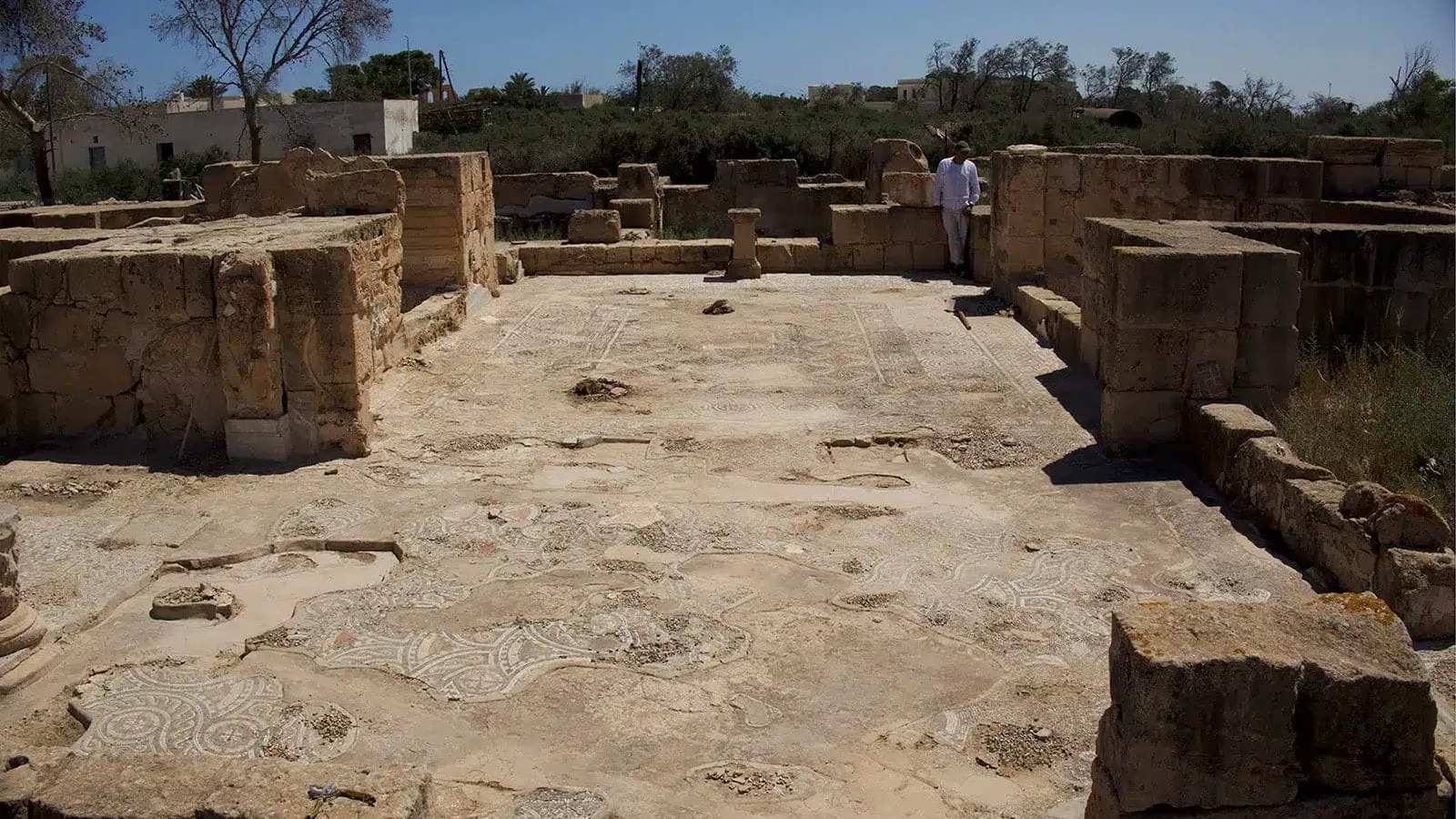
In a preservation effort, archaeologists have reburied approximately 150 square meters of fragile Roman mosaic floors at the Sabratha archaeological site in western Libya. The site, known as "Baths of Area 7," features Roman ruins dating back to the second century AD. The reburial process was part of a project aimed at managing Libya's cultural heritage.
The project, which took around 400 hours to complete over five days, was led by British researcher Will Wooton and his team in collaboration with the Libyan Department of Antiquities. The work involved a team of 11 people, including project staff, students, and local workers, who gained valuable hands-on experience in conservation techniques.
The decision to rebury the mosaic floors was made due to their fragile state, with loose pieces known as "tesserae" posing a significant risk of collapse. The presence of deep-rooted trees also added to the danger, prompting workers to carefully trim the roots rather than removing them to avoid causing further damage.
To protect the site, researchers documented the condition of the floors and installed plastic mesh and ceramic and wooden supports to safeguard protruding sections. They then used around 122 tons of materials to construct three protective layers, consisting of local soil, coarse sand, and gravel, which brought the final cover thickness to approximately half a meter in the six main rooms.
The total cost of the operation was 18,000 dinars, and while the team was unable to provide secure support materials for the wall mosaics, leaving them exposed in two basins. The researchers emphasized that this engineering solution was designed to allow water drainage and limit plant growth, successfully withstanding recent heavy rainfall.
Although reburial reduces maintenance costs and provides adequate protection, it is not a definitive solution, as the site will require regular monitoring and specialized restoration interventions when expertise and funding become available. The Roman baths in Sabratha, dating back to the second century AD, feature rooms for cold, warm, and hot water, adorned with panels and sculptures.
The site was in use until the late fourth century AD, likely abandoned following a devastating earthquake in 365 AD. According to Greek Reporter, the preservation effort aims to protect Libya's cultural heritage and prevent further deterioration of the rare Roman mosaic floors.
Key points
- Archaeologists reburied 150 sqm of fragile Roman mosaic floors at Sabratha to protect them from deterioration.
- The reburial process took 400 hours to complete and involved a team of 11 people.
- The preservation effort aims to protect Libya's cultural heritage and prevent further deterioration of the rare Roman mosaic floors.