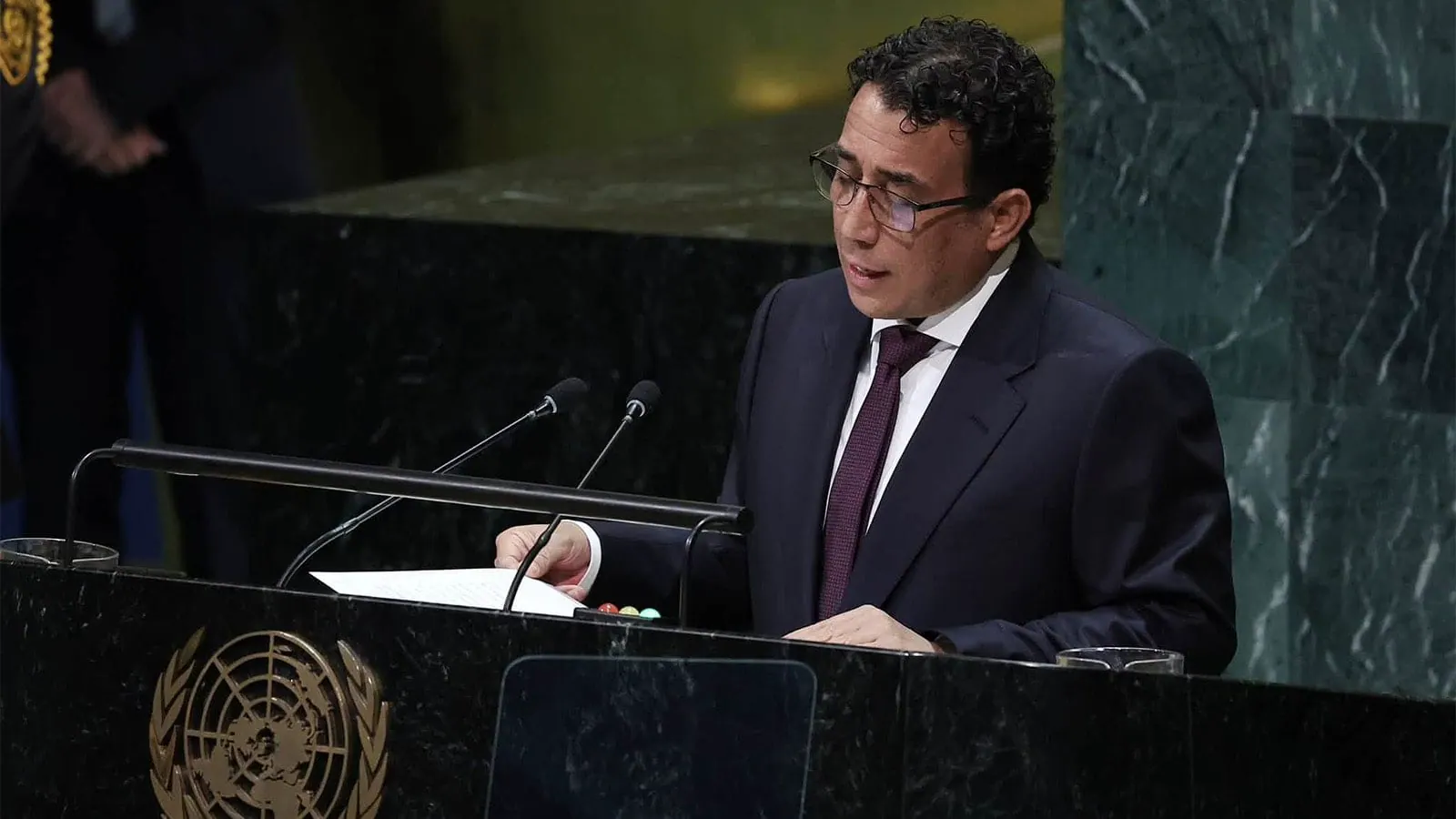
On September 24, 2026, Mohamed al-Menfi, head of Libya's Presidential Council, addressed the United Nations General Assembly, emphasizing the need for the international community and the Security Council to take serious consideration of UN recommendations on human rights abuses in Libya. He stressed that the Security Council must take necessary actions to ensure effective implementation of its decisions without selectivity or double standards. Al-Menfi's statement comes amid ongoing challenges in Libya, where the country has suffered from divisions and power struggles.
Al-Menfi highlighted that Libya has paid a heavy price due to regional and international power struggles being played out on its territory. He conveyed a message to the international community, stating that a true partner to Libya would seek a strong, stable, and unified nation, rather than one that benefits from continued division or seeks to bolster one faction over others. This message reflects Libya's desire for genuine international cooperation aimed at stability and development.
The head of Libya's Presidential Council urged countries to compete in Libya based on investment, reconstruction, energy, technology, and development, rather than seeking influence within state institutions. He emphasized that Libya no longer needs "crisis management" but a genuine will to end years of division. Al-Menfi's remarks underscore a shift in Libya's approach, seeking substantial international engagement that prioritizes the country's rebuilding and the welfare of its people.
On the domestic political front, al-Menfi outlined four governing principles for any sustainable political process. These include respect for existing legal and constitutional references, warning against creating new political arrangements outside established frameworks, and the importance of national ownership. He emphasized that national ownership is a "red line," stressing that international mediation should not turn into guardianship or the imposition of external solutions.
Al-Menfi pointed out that Libya's experience has shown that fragile settlements and temporary deals often collapse with changes in power balances or shifts in allegiances. He argued that sustainable legitimacy and legality are produced by the will of the people and protected by the law. This involves commitments to transparency in agreements, clear mechanisms for oversight and accountability, and ultimately, a return to the people through free and fair referendums and elections.
In a significant development, al-Menfi announced the launch of a "National Reconciliation Committee," based on national and local initiatives. The committee aims to preempt conflicts, contain escalations, and prevent their recurrence, alongside supporting reconciliation and creating a secure environment for the political and electoral process. He invited all Libyan parties to engage in this framework, highlighting its role in national dialogue and peacebuilding.
The announcement and conditions set by al-Menfi reflect a comprehensive approach to addressing Libya's multifaceted challenges. By calling for international support, emphasizing national ownership, and launching a national reconciliation committee, he aims to pave the way for a sustainable political solution. The success of these efforts will depend on the engagement of all Libyan parties and the international community's willingness to support a stable and unified Libya.
Key points
- Mohamed al-Menfi calls for international support in addressing human rights abuses in Libya.
- He outlines four governing principles for a sustainable political process in Libya.
- Al-Menfi announces the launch of a National Reconciliation Committee to support peace and stability.