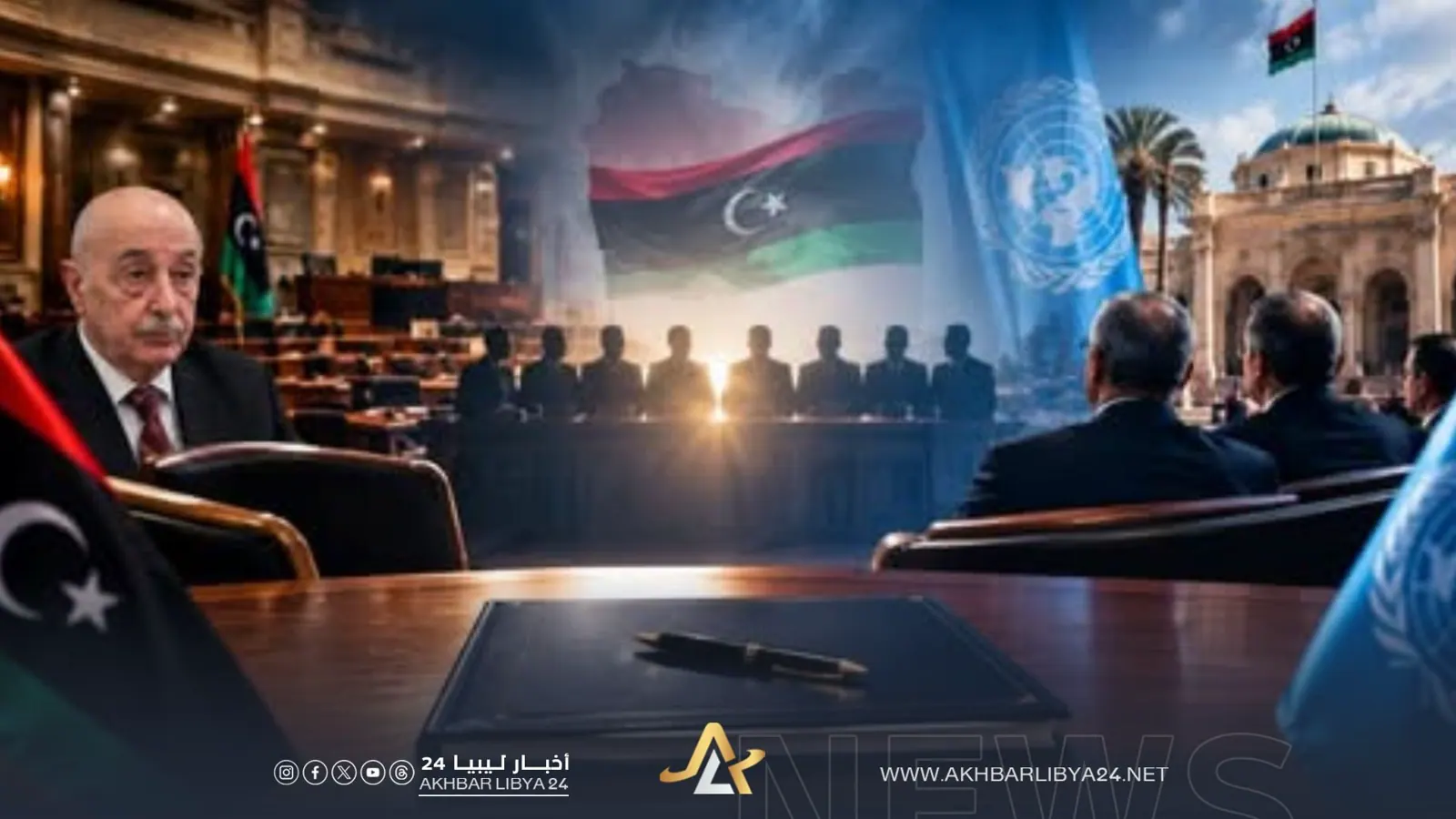
A significant development has emerged in Libya's parliament, with 86 deputies calling for changes to the internal regulations and reforms to the council's operations. This move has put the continuation of Council Speaker Aguila Saleh in question, particularly after the failure of deputies to hold a consultative session at the council's Benghazi headquarters to discuss their demands. The crisis has sparked a broader debate about the future of the council's leadership and the mechanism for transferring power within it.
The crisis has coincided with the recent agreement by the 4+4 mini-dialogue committee, which has the support of the House of Representatives. The agreement includes arrangements for unifying power and pushing for elections. The council announced its support for the agreement on September 14, and the UN mission welcomed it as a step forward. However, the current crisis has raised questions about whether the internal conflict over the council's regulations and leadership will hinder the implementation of the agreement.
Deputy Essam Al-Jehani, one of the prominent voices within the bloc, has described the movement as a reform effort, emphasizing that the 86 deputies can meet in any Libyan city where conditions allow them to exercise their parliamentary duties. Al-Jehani rejected the interpretation of the move as an attempt to inherit Saleh's position, stressing that the motivation is to protest what he describes as the speaker's monopolization of decisions and his insistence on his position.
However, not all deputies share this view, with some predicting that the current movement will retreat, similar to a previous experience in March. Deputy Ali Al-Takbali noted that the main obstacle lies in the difficulty of maintaining a quorum capable of holding a session that could lead to a change in the council's leadership. Al-Takbali believes that while it is possible to gather deputies at a moment of protest, reuniting them later becomes more challenging due to differing interests and local and tribal affiliations.
Another deputy, Mansour Al-Hassi, warned that continued conflict in the current manner could lead to further division within the legislative institution. While insisting on the deputies' right to demand changes to the regulations, Al-Hassi emphasized the need to implement this through legal channels. This stance reflects a trend within the council that sees the conflict over working mechanisms should not turn into a crisis that threatens the unity of the institution itself.
The conflict has also drawn attention from analysts, with some warning that prioritizing changes to the regulations before completing the steps related to the 4+4 agreement could delay its implementation. Analyst Hossam Feneish noted that the UN mission tends to include the agreement in a constitutional amendment, which means that any prolonged crisis within the council could pose an additional obstacle, especially if the conflict over the council's leadership turns into an open struggle over the agenda and powers of the institution.
The crisis has sparked various interpretations, with some seeing it as a genuine effort to reform the council, while others view it as a power struggle. The outcome of the crisis and its impact on the implementation of the 4+4 agreement remain uncertain, with many observers watching closely to see how the situation unfolds. The ability of Council Speaker Aguila Saleh to maintain his position is seen as crucial, with some analysts linking it to his ability to navigate the complex web of alliances and pressures within the council and beyond.
Key points
- The crisis has sparked a broader debate about the future of the council's leadership
- The 4+4 agreement has the support of the House of Representatives
- The crisis has raised questions about the implementation of the agreement