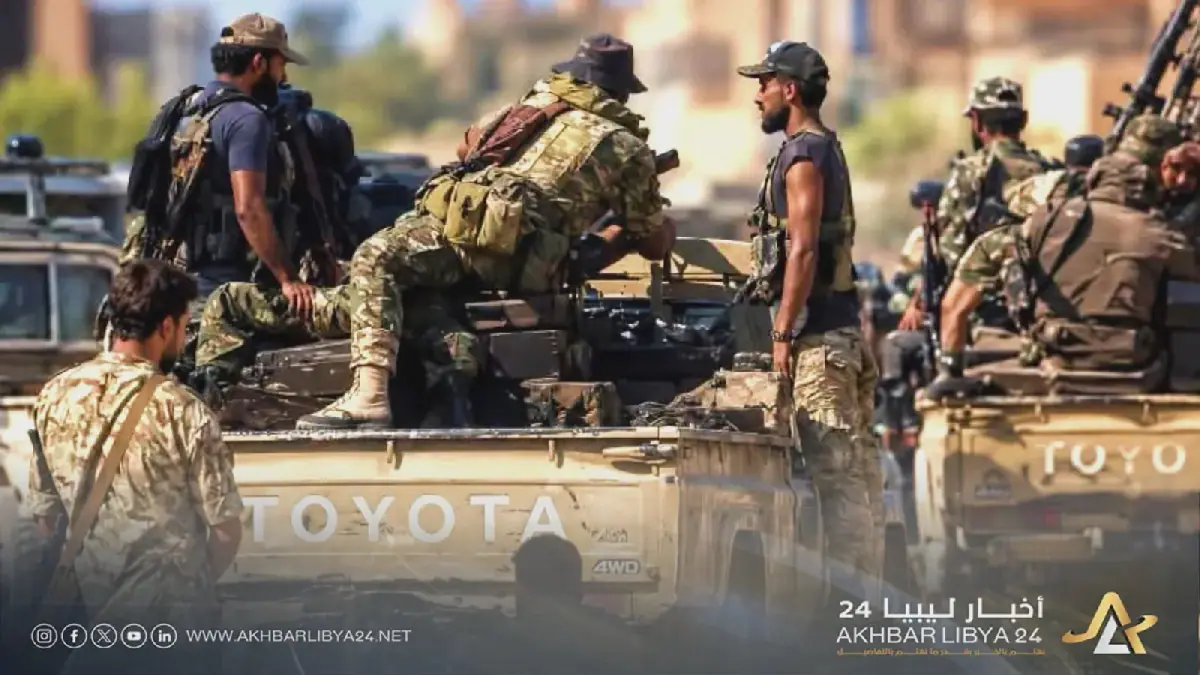
Libya's capital, Tripoli, is grappling with a pressing question about state authority as multiple military and security formations operate in the city. The presence of various armed groups, some linked to the Presidential Council, others to the government of Abdul Hamid Dbeibah, and some under the command of the General Staff and Ministry of Defense, raises concerns about command and control, and the ability of official institutions to impose a unified military and security framework. This situation poses a direct challenge to the concept of a centralized state, which is supposed to have a monopoly on decision-making and security.
Former Ambassador Adel Issa has criticized the multiplicity of military formations in Tripoli, calling for their unification under the umbrella of the Ministry of Defense. He argues that this is a necessary step to end duplication and achieve a unified military institution. This issue is linked to Libya's stability and its ability to transition from a reality where power and influence are fragmented to a state governed by laws and institutions, rather than balances of power and temporary agreements.
The crisis is not limited to the security and military domains, as Libya's education sector is also facing challenges. Universities are struggling, with some threatening to go on strike, while young people celebrate. This paradox highlights the gap between the needs and aspirations of Libya's youth and the reality on the ground, where the education process is faltering and indicators of discontent are rising within academic institutions.
The education sector is crucial for building human capital and preparing skilled personnel for various sectors, including the economy, administration, security, and services. When education is disrupted, and protests and sit-ins become possible, the loss is not limited to an academic year or program but extends to young people's opportunities, the future of the labor market, and the country's ability to build a productive economy.
The recent change in the leadership of the House of Representatives has raised hopes for a revival of stalled national files and a restart of the political process. However, the real value of any change lies not in the replacement of individuals but in the impact it has on performance, decisions, and outcomes. The focus should be on the ability of Libyan institutions to renew themselves and keep pace with the requirements of the current stage.
The transitional government of Abdul Hamid Dbeibah and the Presidential Council face a responsibility to address these issues, particularly regarding unifying security and military institutions and restoring state authority. Building sustainable stability is impossible with multiple references to power, and citizens must see tangible results in terms of security, livelihoods, education, and the ability to exercise their basic rights.
Ultimately, the change in Libya's institutions should not be a superficial process of exchanging positions and posts but should be linked to criteria of efficiency, accountability, and the ability to achieve results. This change must be accompanied by an end to armed chaos and the subjection of all formations to state authority and the law. The national priorities, including unifying the military institution, restoring the regularity of the education process, renewing leadership, and advancing national files, are interconnected elements in the project to restore the Libyan state.
Key points
- Multiple military formations in Tripoli raise questions about state authority
- Unification of military institutions under Ministry of Defense is necessary
- Libya's stability and state authority depend on addressing these challenges