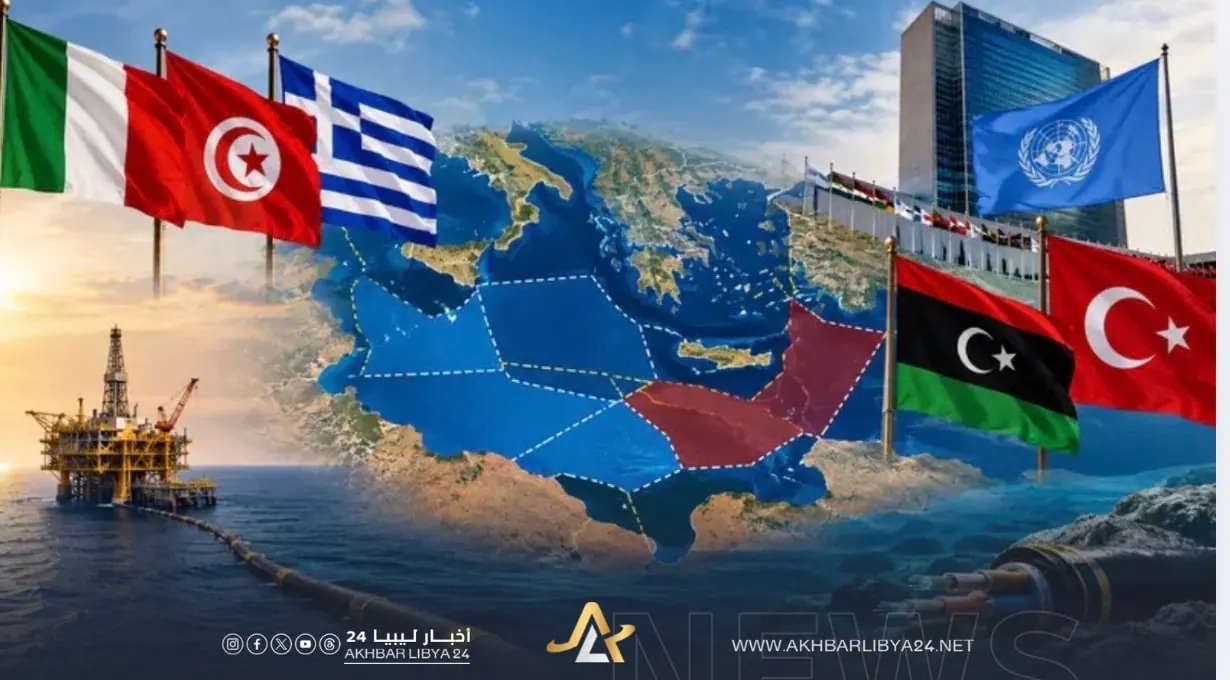
Libya's maritime borders have entered a new phase of complexity, with increasing diplomatic and legal moves by Italy, Greece, and Tunisia. These developments come as the countries involved exchange notes of objection at the United Nations. Each nation asserts its commitment to international maritime law and its respective maritime rights. This situation makes re-drawing the borders a matter that goes beyond the legal aspect to broader economic and strategic calculations.
On September 24, 2026, Italy deposited new lists of geographical coordinates for its normal and straight base lines and closing lines of certain historical bays with the United Nations. This action is based on Italian Law No. 70, issued in May 2026, which concerns the organization and exploitation of marine resources. The law updates the base lines to reflect changes in the coastline and specifies the measurement points used to determine the width of the Italian territorial sea.
Italy's move coincided with an ongoing dispute with Tripoli over Libya's claims to the continental shelf. In May 2026, Italy submitted a note to the United Nations objecting to parts of Libya's position. Italy argued that some Libyan claims affect Italian rights and interests under the law of the sea. This matter is part of a series of objections raised by Mediterranean countries to Libya's defined coordinates and areas.
The dispute is not limited to the Libyan-Italian front, as Greece also rejects parts of Libya's claims, particularly those south of the island of Crete. Greece believes that some Libyan claims contradict the maritime rights of Greek islands. Athens ties its stance to the ongoing controversy over a memorandum of understanding on maritime boundaries signed between Turkey and the Libyan Government of National Accord in 2019.
Tunisia is also involved in the dispute, having objected to parts of Libya's position on maritime boundaries. Tunisia's stance is partly based on a 1982 International Court of Justice ruling regarding the continental shelf between Tunisia and Libya. The parties' positions indicate that the dispute is not just about one line but about interpreting the legal principles governing the delimitation process.
The gas issue transforms the borders into an economic file, with the Mediterranean becoming increasingly important for energy. The expansion of oil and gas exploration and the offering of new maritime areas to energy companies make the boundaries of the continental shelf and economic zones directly relevant to coastal states. The Green Stream pipeline, which connects Libya to Italy, adds a strategic dimension to any maritime dispute between the two countries.
The 2019 memorandum of understanding between Turkey and the Libyan Government of National Accord remains a significant element in the Eastern Mediterranean dispute. Greece considers the memorandum to disregard the maritime rights of Greek islands, while Libya maintains its position on the agreement. The situation reveals that Libya's maritime border file has become part of a broader network of interconnections between Libya, Italy, Greece, Tunisia, and Turkey, with direct involvement of energy interests and maritime infrastructure.
Key points
- The dispute over Libya's maritime borders involves multiple countries and interests
- The situation is complicated by the involvement of energy resources and infrastructure
- The issue may require negotiation or legal settlements between the countries involved