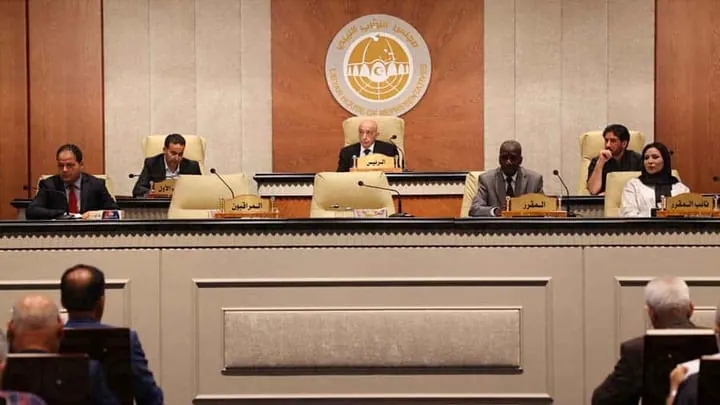
Libya's House of Representatives has issued a package of laws and decisions regarding the political and electoral process, following the agreement of the 4+4 mini-meeting. The laws include amendments to presidential election regulations. The first article of the law stipulates that simultaneous presidential and parliamentary elections be held within 24 months from the date of forming a unified executive authority.
The new law allows individuals with dual nationality to run for president, provided they renounce their foreign nationality before taking the constitutional oath if they win. It also permits military personnel to participate as candidates and voters, provided they resign from military service before taking the oath if they win. If the winner fails to comply with these conditions, they will be replaced by the next winner.
The laws issued by the House of Representatives include freezing the work of Law No. 27 of 2023 regarding the election of the Council of Deputies and reactivating Law No. 10 of 2014 concerning the election of the House of Representatives during the transitional phase until a permanent constitution is issued. The laws grant the next House of Representatives the authority to address constitutional matters and allow parties to participate as individual candidates in all districts.
Through Law No. 5 of 2026, the Parliament made amendments to the law establishing the High National Elections Commission. The Commission will consist of a president, a deputy, and seven full-time members known for their impartiality and non-affiliation with any political entity. To run for president, a candidate must obtain endorsements from 20,000 voters. The law also specifies the mechanism and duration for electoral appeals.
The House of Representatives has issued a decision to reconstitute the High National Elections Commission. The Commission will be chaired by Ibrahim Al-Hamali Atia, with members including Ali Al-Tayeb Abd al-Jawad, Haitham Ali Al-Tabouli, Ali Abu Salah, Sanaa Al-Lishani, Bidiwi Mohamed Bidiwi, and Ali Miftah Al-Mabrouk.
Key aspects of the new electoral laws aim to create a more transparent and fair electoral process in Libya. The laws address various concerns, including the participation of dual nationals and military personnel in the electoral process.
The implementation of these laws is expected to pave the way for future elections in Libya. The international community and Libyan citizens alike are watching closely to see how these changes will impact the country's political landscape.
Key points
- The new laws allow individuals with dual nationality to run for president, provided they renounce their foreign nationality before taking the constitutional oath if they win.
- The laws grant the next House of Representatives the authority to address constitutional matters and allow parties to participate as individual candidates in all districts.
- The High National Elections Commission will be reconstituted, with Ibrahim Al-Hamali Atia as its chair.