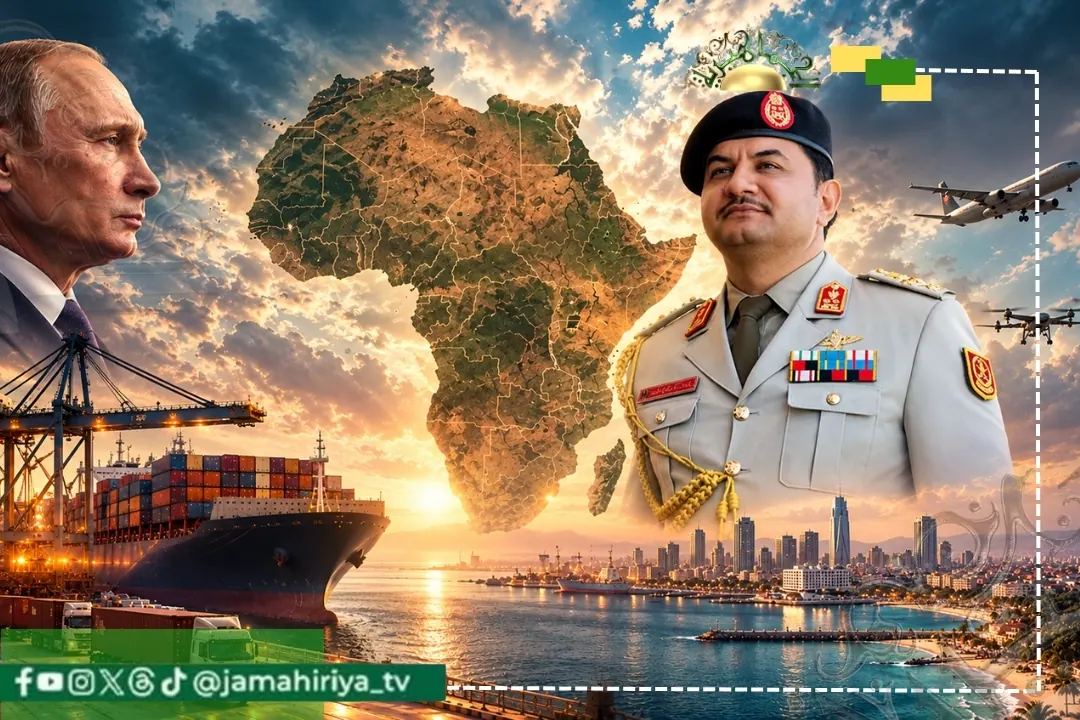
The Libyan Center for Military and Security Studies has warned that Russia is solidifying its military presence in Libya through a network of airbases in areas controlled by Khalifa Hafter's forces. According to the center, this growing Russian presence is linked to recent high-level meetings between Hafter and Russian officials, including President Vladimir Putin and Defense Minister Andrei Belousov. These meetings, which took place in Moscow in August, focused on enhancing military cooperation between the two sides.
The center's report cited analysis from the Tearline project, which is affiliated with the US National Geospatial-Intelligence Agency. The project has tracked development work at six Libyan airbases, including Jufra, Al Khadim, Al Qardabiya, Brak Al Shati, Miton Al Sarrat, and Tamenhint. These bases are said to have undergone construction and renovation, including the building of hangars, aircraft facilities, and support infrastructure since the arrival of the Russian African Legion in 2024.
The strategic location of these airbases allows Russia to project its military power from Libya into North Africa and the Sahel region. The center noted that the presence of these bases provides Moscow with a logistical and military foothold close to the southern flank of NATO. Specifically, the airbases at Miton Al Sarrat and Brak Al Shati are seen as crucial points for potential Russian supply lines to the coast, while the central and eastern bases offer a platform for Russian presence in the Mediterranean.
According to the Libyan Center, the expansion of Russian influence in Libya is facilitated by the country's ongoing military and political divisions. The absence of a unified military institution enables external powers to establish separate security and military arrangements within the country. This has allowed Russia to build a military presence in Libya, which could potentially be used as a hub for further expansion into Africa.
The center's report highlights the potential risks of Russia's growing presence in Libya, warning that the country could transition from a contested zone of influence to a Russian logistical platform connecting the Mediterranean to the Sahel and the African interior. This could have significant implications for regional security and stability, as well as for the balance of power in Africa.
The development of Libya's airbases is seen as part of a broader Russian strategy to expand its influence in Africa. By establishing a military presence in Libya, Russia may be seeking to gain a strategic foothold on the continent and challenge the influence of other global powers. The international community has been watching Russia's growing military presence in Africa with concern, as it could potentially alter the regional security landscape.
The Libyan Center's report emphasizes the need for a unified and stable Libya to prevent external powers from exploiting the country's divisions. The center's warning highlights the potential consequences of inaction, as Libya's instability could have far-reaching implications for regional and global security.
Key points
- Russia's growing military presence in Libya could provide a strategic foothold for expansion into North Africa and the Sahel region.