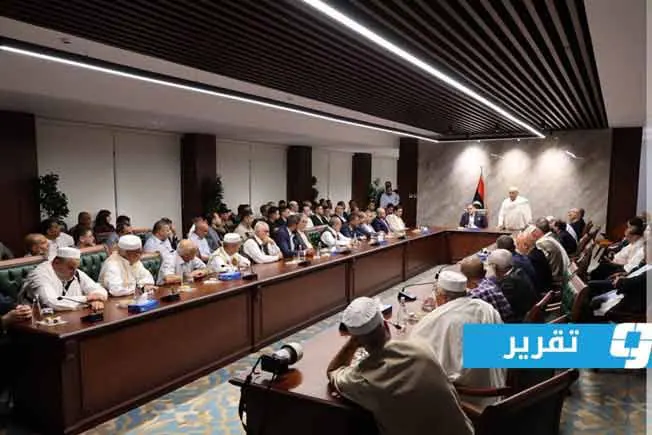
Libya's transitional government, led by Abdul Hamid Dbeiba, is intensifying efforts to rally support for the "4+4" agreement, a plan aimed at resolving the country's political crisis and paving the way for elections. The agreement, signed on August 30, 2026, by a committee comprising representatives from the House of Representatives, the State Council, and the Government of National Unity, outlines a roadmap for the country's transition to stability. Dbeiba has welcomed the agreement, saying it represents a crucial step towards ending the transitional phase and holding elections.
As part of its efforts to build support for the agreement, Dbeiba's government has been engaging with various political and social groups across the country. On September 22, 2026, Dbeiba met with several components from the city of Misrata, where he emphasized the importance of moving forward with the electoral process to achieve stability. The government has also been seeking international backing for the plan, with Dbeiba meeting with senior US officials, including Jeremy Brent, a top policy advisor for Libya at the US State Department.
The "4+4" agreement provides for the formation of a new National High Council for Elections and the amendment of electoral laws, with a view to holding elections within 24 months. The plan has, however, faced resistance from some quarters, including the State Council, which has expressed concerns about the agreement's legitimacy. The council, along with several political parties, has argued that the agreement cannot be implemented without reference to the country's constitutional declaration and existing legislation.
Despite these challenges, Dbeiba's government remains committed to pushing forward with the agreement. The government has pointed to the need for a unified national approach to address the country's many challenges. In a meeting with Hana Titeh, the UN's special representative to Libya, Dbeiba emphasized the importance of supporting national reconciliation efforts and promoting a unified national approach to address the country's many challenges.
The agreement has also faced criticism from within the House of Representatives, where 64 lawmakers have questioned the legitimacy of the session that approved the plan, citing concerns about the quorum. The opposition has threatened to hold a separate session to choose a new leadership for the council. These developments have raised questions about the agreement's prospects for success and the potential for further divisions within the country's already fractured political landscape.
As the situation continues to evolve, it remains to be seen whether Dbeiba's government can overcome the obstacles and build the necessary support for the "4+4" agreement. The plan's success will depend on the government's ability to address the concerns of various stakeholders and build a broad-based consensus on the way forward. With Libya's transition to stability hanging in the balance, the international community is watching closely to see how events unfold.
The developments in Libya have significant implications for the country's future, with the "4+4" agreement representing a critical juncture in the country's transition to stability. As the government continues to engage with various stakeholders, the need for a unified national approach to address the country's many challenges has become increasingly clear. With the international community providing support, Libya's transitional government faces a daunting task in building the necessary consensus to move the country forward.
Key points
- The Libyan government is intensifying efforts to rally support for the "4+4" agreement, a plan aimed at resolving the country's political crisis and paving the way for elections.
- The agreement has faced resistance from some quarters, including the State Council, which has expressed concerns about the agreement's legitimacy.
- The success of the agreement will depend on the government's ability to address the concerns of various stakeholders and build a broad-based consensus on the way forward.