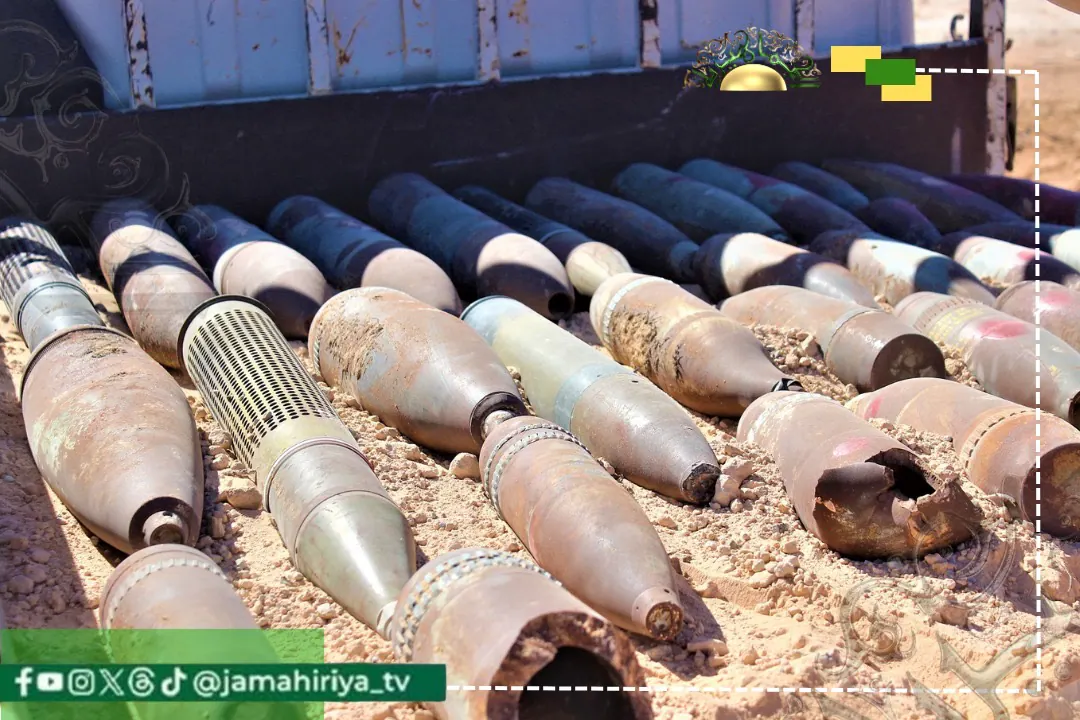
A recent report by Aljamahiriya TV and Sky News Arabia has highlighted the massive challenge facing Libya's reconstruction efforts. In a nine-month period, over 14,000 explosive remnants were removed from a single farm in Misrata. This finding underscores the vast scale of Libya's unexploded ordnance problem, which has persisted since the 2011 conflict. The issue poses significant risks to civilians and hampers efforts to rebuild and develop the country.
According to Sky News Arabia, approximately 167 square kilometers of high-risk areas remain uncleared as of 2026. This leaves extensive areas under threat from unexploded ordnance. The Libyan Center for Mine Action has documented over 1.214 million square meters of new contamination, while clearing around 1.59 million square meters, of which 99% has been returned to local communities.
Since 2011, demining operations have successfully disposed of over 1.06 million pieces of explosive ordnance and cleared more than 50 million square meters. However, several regions, including Zuwara, Tobruk, Sabha, Ubari, Brak Al-Shati, southern Tripoli, southern Sirte, Al-Jufra, Benghazi, and Derna, still require intervention to remove war remnants.
The ongoing contamination not only endangers civilians but also threatens designated residential, agricultural, and construction areas, as well as roads and reconstruction projects. Therefore, thorough surveys and clearance operations are essential before land can be utilized and new projects implemented. The presence of unexploded ordnance obstructs the use of large areas and poses a considerable risk to the population.
The proliferation of weapons and recurrent conflicts in Libya since 2011 have resulted in the accumulation of substantial quantities of mines, explosive remnants, and war debris across various regions. The consequences of this security chaos have extended to agricultural lands, residential areas, roads, and infrastructure, leaving behind unexploded ordnance that imperils residents and impedes the development of new areas.
The continued presence of war remnants over a decade after 2011 underscores the substantial security and humanitarian costs that persist in Libya. Comprehensive survey and clearance efforts will require significant resources and endeavors to safeguard civilians and support reconstruction initiatives. Libya's situation demands sustained attention and cooperation from national and international stakeholders to address this critical challenge.
Key stakeholders, including the Libyan government and international organizations, must collaborate to provide necessary resources and support for demining operations. Effective coordination and resource allocation will enable the safe and efficient removal of explosive remnants, ultimately facilitating Libya's reconstruction and development. The international community's engagement will play a vital role in mitigating the risks associated with unexploded ordnance and promoting stability in the region.
Key points
- Over 14,000 explosive remnants were removed from a single farm in Misrata, highlighting the scale of Libya's unexploded ordnance problem.
- Around 167 square kilometers of high-risk areas remain uncleared as of 2026.
- Since 2011, over 1.06 million pieces of explosive ordnance have been disposed of, and more than 50 million square meters cleared.