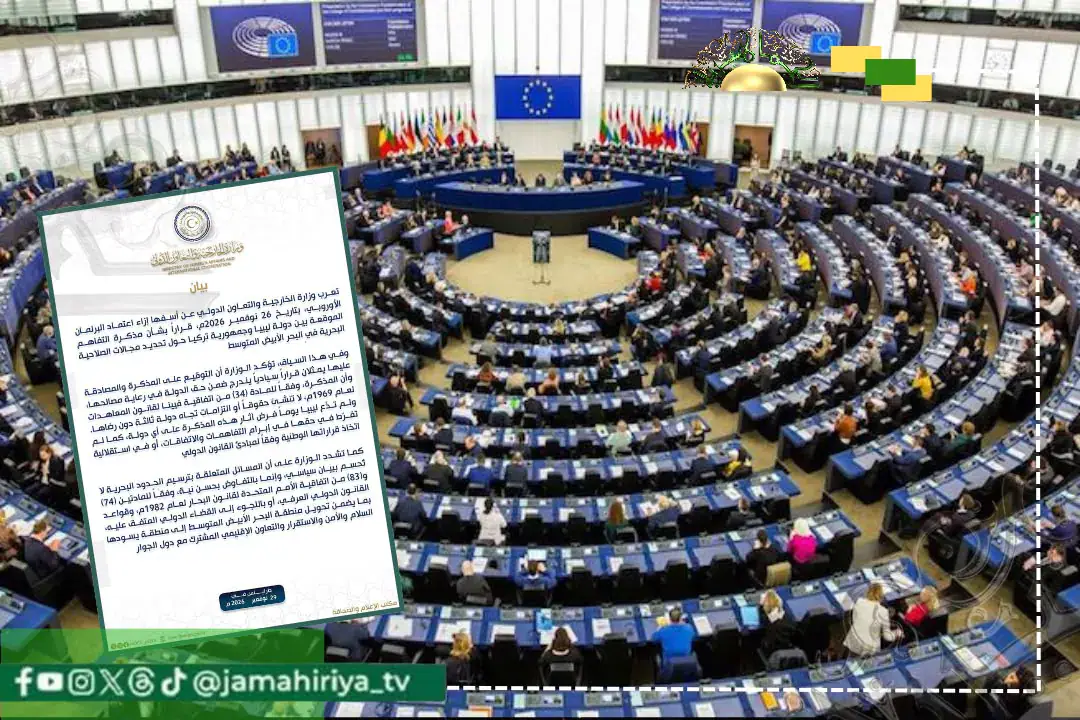
The Libyan government, led by Prime Minister Abdul Hamid al-Dbeibah, has voiced its disappointment over a recent decision by the European Parliament regarding a maritime border agreement with Turkey. On November 26, the European Parliament made a statement on the memorandum of understanding signed between Libya and Turkey. The Libyan Ministry of Foreign Affairs and International Cooperation stated that the agreement is a sovereign decision that falls within Libya's right to protect its national interests and independence.
The Libyan government emphasized that the signing and ratification of the memorandum do not create rights or obligations towards any third country without its consent, in accordance with the Vienna Convention on the Law of Treaties of 1969. The ministry also clarified that Libya did not seek to impose the effects of the agreement on any country and did not waive its right to conclude international agreements and understandings. This statement highlights Libya's commitment to upholding its sovereignty and international law.
According to the Libyan government, the demarcation of maritime borders is not determined by political statements, but rather through good-faith negotiations or recourse to international courts agreed upon by the parties involved. The ministry stressed that any disputes related to maritime borders should be resolved in accordance with the United Nations Convention on the Law of the Sea and international law. This approach aims to promote peace, security, stability, and regional cooperation in the Mediterranean.
The European Parliament's decision has sparked concerns in Libya, with the government reiterating its commitment to protecting its national interests. The Libyan Ministry of Foreign Affairs and International Cooperation called for the resolution of maritime disputes through diplomatic channels and in accordance with international law. This stance reflects Libya's efforts to maintain its sovereignty and independence in the face of external pressures.
The maritime border agreement between Libya and Turkey has been a point of contention in the region, with some countries expressing concerns over its implications. However, the Libyan government remains firm in its stance, emphasizing that the agreement is a sovereign decision that does not infringe on the rights of other countries. The government has also reiterated its commitment to upholding international law and promoting regional cooperation.
The Libyan government's rejection of the European Parliament's decision highlights the complexities of the country's foreign policy. Libya has been working to rebuild its international relations and assert its sovereignty since the ousting of former leader Muammar Gaddafi in 2011. The government's stance on the maritime border agreement reflects its efforts to balance its relationships with regional and international partners.
The issue of maritime borders in the Mediterranean remains a contentious issue, with several countries vying for influence in the region. The Libyan government's commitment to resolving disputes through diplomatic channels and in accordance with international law is seen as a positive step towards promoting regional stability. As the situation continues to unfold, it remains to be seen how the European Parliament and other regional actors will respond to Libya's stance on the maritime border agreement.
Key points
- The Libyan government rejects the European Parliament's decision on the maritime border agreement with Turkey, citing its sovereignty and commitment to international law.