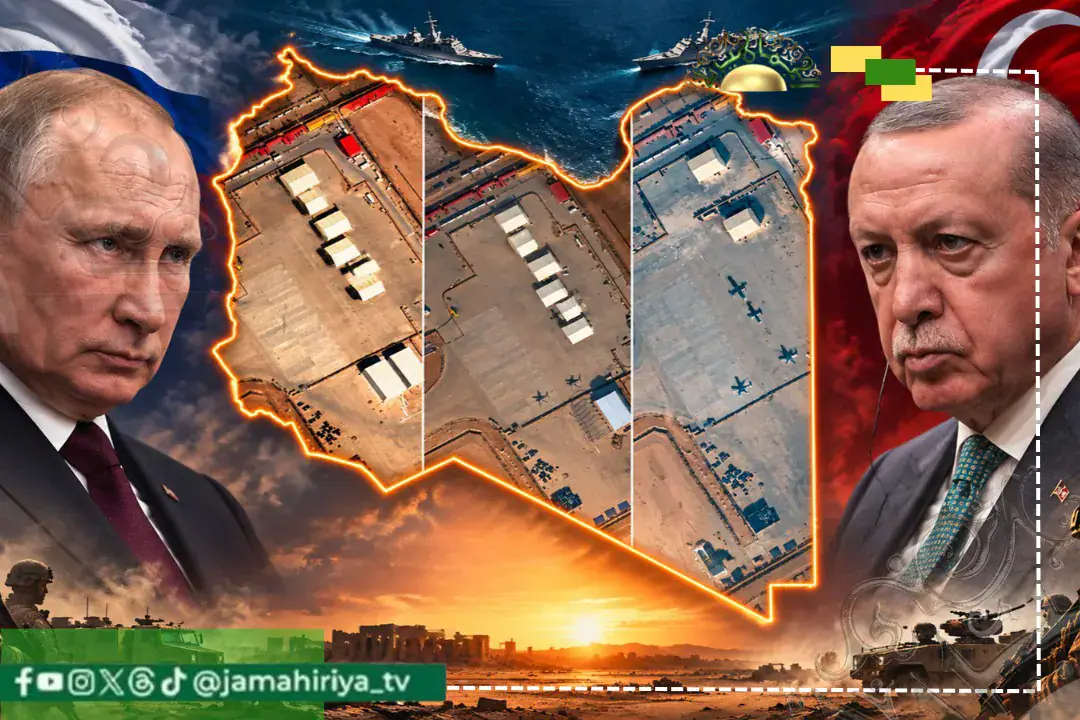
Libya has become a critical location for the intersection of influence projects between Russia and Turkey, according to a report by Aljamahiriya TV. Following the 2011 uprising, the country has been divided politically and militarily, with its ports, airbases, and desert borders being used to serve interests beyond its borders. The report noted that a recent Ukrainian attack on Russian ships in the port city of Benghazi cannot be separated from Russia's expanding logistical role in the region.
Russia has been increasing its presence in Libya, using the country as a point of passage for its influence in Africa. The report cited a study by the US-based Terline platform, which found that Russia has been developing six airbases in Libya, including Al-Khadim, Al-Jufra, and Brak Al-Shateh. These developments are seen as helping Moscow secure a military foothold in North Africa and the Sahel region. Russia's interest in Libya lies in its strategic location, which allows it to support its expansion in Mali, Niger, Burkina Faso, and the Central African Republic.
Turkey, on the other hand, views Libya as part of a broader regional project that encompasses eastern Mediterranean security, energy, and maritime trade routes. The 2019 maritime agreement between Turkey and the Tripoli government gave the relationship a strategic dimension that goes beyond military cooperation. However, Turkey has recently been seeking to improve relations with Khalifa Haftar's camp, which has led to a shift in its policy towards Libya.
The report noted that Libya's transformation into a hub for Russian and Turkish influence has raised concerns about the country's stability and sovereignty. The continued division of the country and the lack of unified control over its ports, airbases, and strategic facilities have created an environment in which external powers can exert their influence. This has led to fears that Libya may become a proxy conflict between international powers.
Russia's interest in developing Libya's infrastructure, including the port of Tobruk, is seen as a way to expand its naval and logistical capabilities in the Mediterranean. This development has significant implications for the regional balance of power and has raised concerns among Libya's neighbors. The country's strategic location makes it an important player in regional security and energy dynamics.
The Turkish-Russian rivalry in Libya is complex, with both countries having different goals and alliances. While Russia seeks to expand its military presence in the country, Turkey is focused on securing its interests in the eastern Mediterranean and protecting its energy investments. The situation in Libya remains volatile, with multiple external powers vying for influence in the country.
The international community has expressed concerns about the escalating rivalry between Russia and Turkey in Libya, which could have significant implications for regional stability and security. The situation in Libya highlights the challenges of managing external influence in fragile states and the need for a coordinated international response to prevent further instability in the region.
Key points
- Russia and Turkey are competing for influence in Libya, with both countries seeking to expand their presence in the region.