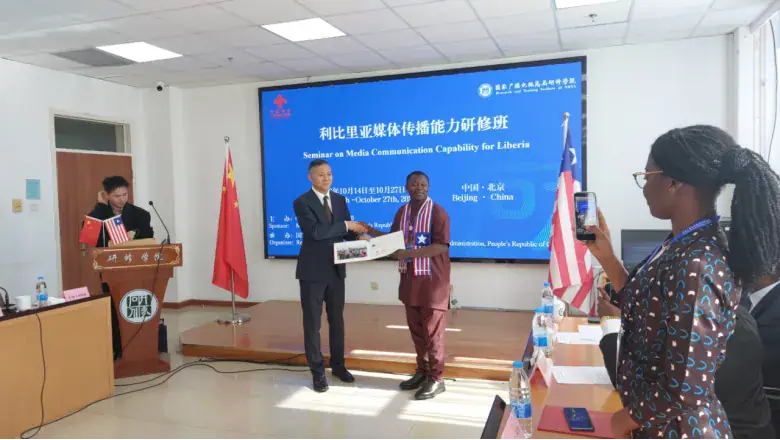
Twenty-three Liberian journalists have completed a two-week media training program in China, gaining new insights and international connections. The training, organized by the Research and Training Institute of China's National Radio and Television Administration, covered media communication, international reporting, and combating fake news. The journalists, from state-run and private media institutions, were urged to apply their new skills to improve journalism in Liberia.
The challenge to apply the training was issued by Bai S. G. Best, leader of the Liberian media delegation and Vice President of the Publisher Association of Liberia. In his closing remarks, Best asked participants if they would "grow" and make a positive impact in their newsrooms. He emphasized that the significance of the trip would not be measured by certificates or experiences, but by what happens when they return to their newsrooms and resume reporting.
The training program included visits to Chinese media institutions, lectures, and professional discussions. Participants had to adjust to Beijing's autumn weather, an eight-hour time difference with Monrovia, and unfamiliar foods and customs. Despite the challenges, Best described the experience as physically demanding, intellectually challenging, and culturally enriching. The delegation brought together journalists from different institutions, backgrounds, and professional circles.
Best encouraged participants to adopt constructive journalism, an approach that examines public problems and investigates possible solutions. He hoped they would return to their newsrooms with a renewed determination to produce reporting that helps society understand its challenges. Constructive journalism should not mean avoiding difficult questions or protecting powerful interests from scrutiny, but rather complementing investigative and accountability reporting.
The training program concluded on October 27, with participants receiving certificates and gifts. Gabriel Mills, Minister Counselor for Press at the Liberian Embassy in China, also urged beneficiaries to put their new skills to use. He commended the Chinese government and the Chinese Embassy for providing the training opportunity. The central concern remains relevant to Liberia's media landscape: what changes will the training produce in the way Liberian journalists report?
Best's message had a practical edge, acknowledging that participants may face skepticism and resistance when introducing new ideas in their newsrooms. He emphasized that meaningful change has never been easy and requires commitment, professional discipline, and an environment that supports journalists. The image of a leaf was used to describe how one small contribution can help enrich an entire community.
The test will be whether the lessons from the seminar can be incorporated into everyday newsroom decisions without compromising editorial independence, accuracy, or the media's watchdog role. The journalists' ability to apply their new skills and knowledge will determine the impact of the training program on Liberia's media landscape.
Key points
- Liberian journalists are urged to apply the skills and knowledge gained from a China training program to improve local journalism.
- The training program covered media communication, international reporting, and combating fake news.
- The journalists were encouraged to adopt constructive journalism, an approach that examines public problems and investigates possible solutions.