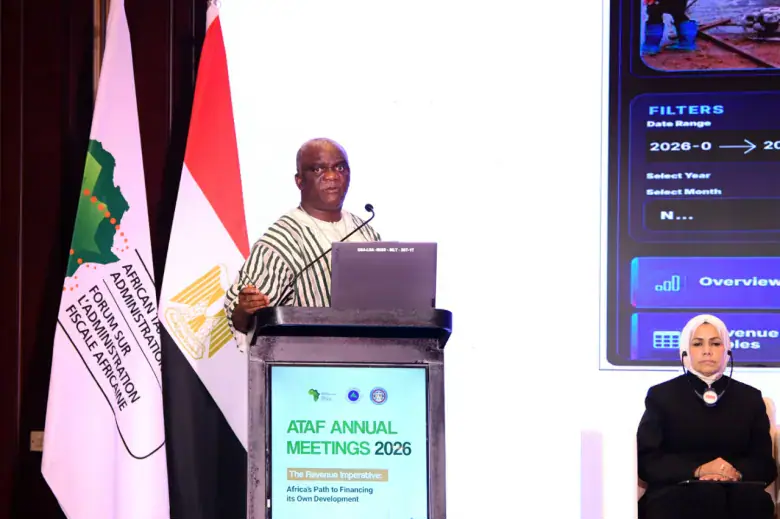
Liberia's move towards self-sufficiency in funding its development was highlighted at the African Tax Administration Forum (ATAF) 2026 Annual Meetings and General Assembly in Cairo. Liberia Revenue Authority (LRA) Commissioner General James Dorbor Jallah presented the country's recent fiscal achievements and plans for modernizing tax collection. He shared Liberia's experience in a session titled "Domestic Resource Mobilisation: Differentiated Pathways for a Diverse Continent."
Under the current management team's leadership since 2023, Liberia's revenue collections have seen significant growth. The collections stood at approximately $612 million when they took charge. Since then, the numbers have steadily increased, reaching $699 million in 2024 and $848 million in 2025. The current figure stands at about $1.134 billion, with an additional $5 million brought forward, totaling around $1.139 billion.
The LRA's transformation is built on five key pillars: strategic leadership, technology and data, compliance and enforcement, customs and tax administration, and institutional integrity. These pillars aim to enhance performance, increase collections, and make the revenue system more accountable to the public. Jallah cited the dismissal of 46 LRA employees in 2025 for fraud and related misconduct as evidence of the Authority's commitment to integrity and transparency.
The LRA has also introduced a public revenue dashboard, an online tool that allows citizens to track government collections in near-real time. The platform provides monthly summaries, figures broken down by revenue category and tax type, and is part of a broader transparency drive. This includes expanding electronic payment options and other online services to make tax compliance easier and more accessible.
Another initiative showcased was the LRA's virtual contact center, featuring a virtual assistant named Fatu. This service aims to provide taxpayers with easier access to guidance and support, reducing wait times and confusion about tax obligations. Once fully operational, the center is expected to support taxpayer education and provide advice to individuals and companies without requiring them to visit an LRA office.
Jallah emphasized that raising revenue is only part of the goal; lasting domestic resource mobilization requires institutional reform, openness, accountability, and engagement with taxpayers. The LRA is working to modernize tax administration, making compliance simpler for small enterprises while maintaining smooth operations as systems go digital. The goal is to become a transparent, accountable, and technology-driven institution that supports Liberia's long-term growth.
The session at the ATAF meeting brought together tax officials and academic experts to discuss boosting domestic revenue in African states under varying economic and institutional conditions. Participants agreed that reform plans should reflect each country's unique circumstances, development goals, and institutional strength, rather than following a one-size-fits-all approach. The discussions highlighted the challenges facing economies with large informal sectors, newly formalizing markets, rapid digital growth, and abundant natural resources.
Key points
- Liberia's revenue collections have grown from $612 million to over $1.134 billion under the current management team's leadership.
- The LRA's transformation is built on five pillars, including strategic leadership, technology and data, and institutional integrity.
- The LRA has introduced a public revenue dashboard and a virtual contact center to enhance transparency and taxpayer engagement.