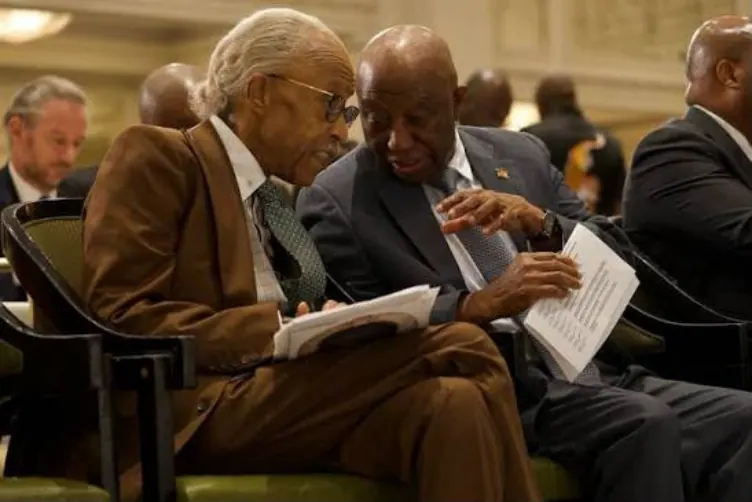
Liberian President Joseph Nyuma Boakai, Sr. recently met with Reverend Al Sharpton, a prominent civil rights activist and founder of the National Action Network, on the sidelines of the United Nations General Assembly. The meeting, described by Sharpton as "meaningful," focused on strengthening the relationship between Africa and the diaspora. They discussed Africa's role on the global stage and the responsibility to help build, invest in, and uplift the continent. Sharpton praised President Boakai and his staff as "gracious and welcoming."
The meeting between Sharpton and Boakai is part of a long-standing pattern of Black Americans and Africans coming together to discuss their shared history and responsibilities. Liberia, founded in 1822 by the American Colonization Society, is a country born of the diaspora story. The settlers' arrival on the Grain Coast was not a simple homecoming, as it created a divide between Americo-Liberians and indigenous Liberians that shaped the country's politics for over a century. This divide remains part of Liberia's unfinished reckoning.
President Boakai also participated in a high-level gathering on African cultural heritage, co-hosted by Ghana, Germany, and France, with UNESCO Director-General Khaled El-Enany in attendance. At this event, Boakai proposed a Liberia–Ghana Cultural Heritage and Historical Recovery Cooperation Framework. This framework aims to digitize historical records, train archivists and museum professionals, research and preserve historic sites, and develop exhibitions and educational programs. The goal is to go beyond the physical return of objects and focus on cooperation and knowledge sharing.
The proposed cooperation framework between Liberia and Ghana is an effort to advance reparatory justice and the restitution of cultural heritage. President Boakai argued that restitution should be about more than just returning physical objects. He suggested that the two countries appoint a small technical working group to identify immediate areas of cooperation, leading to a formal agreement. This initiative reflects a broader conversation about the diaspora's role in Africa's development and the need for partnership and progress.
The conversation between Sharpton and Boakai comes at a sensitive moment for Liberians in America. The issue of protected immigration status for Liberians in the United States has been a long-standing concern. Since March 1991, certain Liberians have been eligible for Temporary Protected Status or Deferred Enforced Departure (DED). While Congress passed the Liberian Refugee Immigration Fairness provision in 2019, providing a path to permanent residency for some Liberians, DED for Liberia expired on June 30, 2026.
Reverend Sharpton closed his Instagram post by calling for partnership, progress, and action. For Liberia, which was built by people crossing the Atlantic in the opposite direction from their ancestors, the test will be whether such meetings produce tangible results. This could include heritage cooperation, investment, or protection for Liberians living in America. The meeting between Sharpton and Boakai has sparked both interest and debate, with some commenters asking about the status of Liberians in the United States.
The relationship between Liberia and the diaspora is complex and multifaceted. Liberia has a long history of engagement with the diaspora, from Edward Wilmot Blyden's 19th-century arguments for a shared destiny between Africans and their descendants to Marcus Garvey's Universal Negro Improvement Association's back-to-Africa ambitions in the 1920s. The African Union has recognized the diaspora as the continent's "sixth region," and initiatives like Ghana's 2019 "Year of Return" have drawn thousands of African Americans to the continent.
Key points
- The meeting between Reverend Al Sharpton and President Joseph Nyuma Boakai, Sr. highlights the ongoing conversation about the relationship between Africa and the diaspora.
- President Boakai proposed a Liberia–Ghana Cultural Heritage and Historical Recovery Cooperation Framework to advance reparatory justice and cultural heritage restitution.
- The conversation between Sharpton and Boakai comes at a sensitive moment for Liberians in America, with concerns about protected immigration status and a call for partnership, progress, and action.