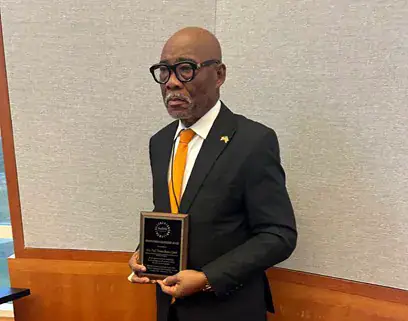
Liberian lawmaker Thomas Romeo Quioh, Chairman of the House Committee on Elections and Inaugurations, has emphasized the need for a cautious approach to granting voting rights to Liberians living abroad. Speaking at the Liberian Diaspora 2026 Summit in Columbus, Ohio, Quioh argued that the country's Constitution already permits absentee voting, but lacks the necessary statutory machinery to make it effective. He cited Article 77(b) of the 1986 Constitution, which guarantees the right to register and vote for citizens 18 years and above.
Quioh pointed out that a 2004 amendment to the Elections Law deleted a provision that allowed registered voters absent from Liberia to request absentee ballots. He stressed that the idea of voting from outside Liberia is not new to Liberia's electoral jurisprudence. Quioh drew a clear distinction between dual citizenship and overseas voting, two issues often confused in public debate. He noted that Liberia's 2022 amendment to the Aliens and Nationality Law allowed Liberians to hold another citizenship without losing Liberian citizenship.
Quioh outlined a six-step plan to facilitate overseas voting, starting with amending the Elections Law to include a dedicated chapter on Out-of-Country Voting. He called for clarifying the role of the National Elections Commission (NEC) in establishing and supervising overseas registration centers and polling stations. Quioh also urged a credible overseas registration system, securely verifying citizenship, age, and identity, and preventing double registration and double voting.
Quioh recommended starting with supervised in-person voting at diplomatic locations, warning against rushing into electronic voting without proven cybersecurity, transparency, and public confidence. He emphasized the need for adequate financing and capacity building for the NEC to implement overseas voting. Quioh proposed a practical roadmap, beginning with a joint legal assessment by the Legislature, the NEC, and the Ministry of Justice, followed by legislative action to amend the Elections Law.
The lawmaker cited Ghana, Nigeria, South Africa, and Senegal as useful comparative examples for Liberia to study and adapt lessons from. He stressed that the objective should not simply be to announce that overseas voting has been authorized, but to establish a system that can be implemented credibly and sustainably. Quioh's proposal aims to ensure that Liberians living abroad can exercise their right to vote without compromising the integrity of the electoral process.
With the 2029 general and presidential elections approaching, Quioh's roadmap is seen as a timely initiative. The NEC's 2026–2030 Strategic Plan is already in place, and Quioh's proposal provides a clear direction for implementing overseas voting. His emphasis on caution and careful planning reflects concerns about the potential risks and challenges associated with electronic voting.
Quioh's address at the Liberian Diaspora 2026 Summit provided a nuanced analysis of the complexities surrounding overseas voting. His distinction between dual citizenship and overseas voting, as well as his emphasis on statutory machinery, highlights the need for a comprehensive approach to addressing the voting rights of Liberians abroad. As the country moves towards the 2029 elections, Quioh's proposal is likely to inform the national conversation on this critical issue.
Key points
- Quioh warns against rushing into electronic voting without proven cybersecurity, transparency, and public confidence.