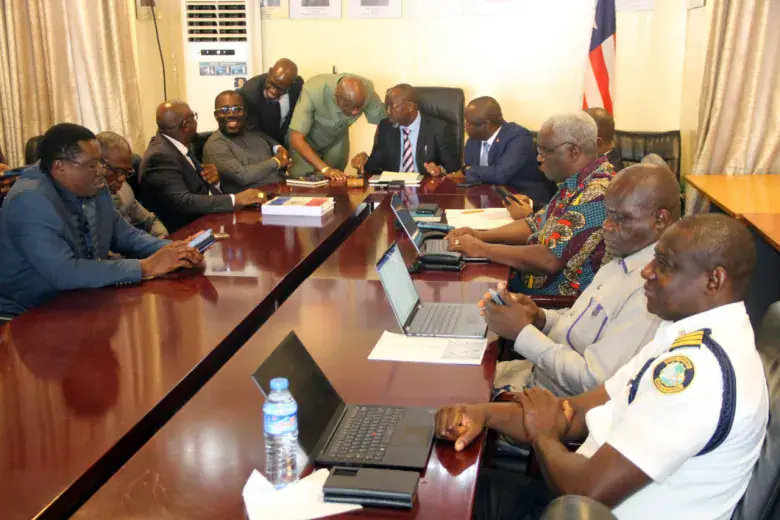
The Chairman of the House Committee on Ways, Means, Finance and Budget, Representative P. Mike Jurry, has initiated a hearing to scrutinize the proposed FY2027 National Budget's revenue framework. The committee aims to assess the realism, equity, administrative achievability, and sufficiency of the $1.54 billion plan in supporting Liberia's development priorities. Representative Jurry assured Liberians that lawmakers will conduct due diligence to ensure the proposed financial instrument serves the nation's interests.
The hearing will focus on several key aspects, including examining the credibility and feasibility of the proposed FY2027 revenue projections, assessing the assumptions and methodologies behind the estimates, and reviewing FY2026 collection performance. The committee will also evaluate the capacity of revenue-generating institutions and identify areas for improvement. Representative Jurry emphasized that domestic revenue mobilization is crucial to Liberia's fiscal sovereignty and long-term economic independence.
Representative Jurry identified several key issues requiring legislative attention, including revenue leakages, exemptions, concessions, weaknesses in revenue administration, and statutory obligations of state-owned enterprises. The committee will seek to find remedies to these issues and provide evidence-based recommendations to inform legislative consideration and approval of the FY2027 National Budget. He stressed that revenue mobilization must be fair and that compliant taxpayers and legitimate businesses should not bear an unreasonable burden.
Deputy Minister for Fiscal Affairs at the Ministry of Finance and Development Planning, Anthony G. Myers, defended the proposed $1.54 billion Fiscal Year 2027 National Budget. He projected a significant increase in domestic revenue collection, despite concerns over the feasibility of the estimates and the absence of major one-off mining signature bonuses. The proposed budget represents an 11.5 percent increase over the FY2026 year-end revenue estimate of $1.380 billion and 18.1 percent above the approved FY2026 budget of $1.303 billion.
Deputy Minister Myers noted that the FY2027 revenue projection is built primarily on recurring domestic revenue rather than one-off receipts. Tax revenue is expected to increase by 26.5 percent, from $847.5 million to $1.072 billion. He explained that the FY2026 revenue performance benefited from exceptional mining receipts, including over $220 million in signature bonuses, but the FY2027 forecast deliberately excludes similar windfalls from its baseline assumptions.
The Deputy Minister outlined several policy measures expected to support the FY2027 revenue target, including the implementation of a 15 percent Value Added Tax (VAT), a two percent advance corporate income tax on mining and agriculture companies, and stronger tax compliance and administration. VAT will replace the existing 13 percent Goods and Services Tax (GST) effective January 1, 2027, and is projected to generate $224.8 million.
The hearing provides lawmakers with an opportunity to question the Ministry of Finance, the Liberia Revenue Authority (LRA), and other revenue-generating institutions on the assumptions, risks, and policy measures underpinning the FY2027 revenue estimates. The committee's examination aims to ensure that the proposed revenue framework is realistic and sufficient to support Liberia's development priorities.
Key points
- The proposed FY2027 revenue framework is $1.54 billion, representing an 11.5 percent increase over the FY2026 year-end revenue estimate.
- The revenue projection is built primarily on recurring domestic revenue rather than one-off receipts.
- The implementation of a 15 percent Value Added Tax (VAT) is expected to generate $224.8 million.