An independent Liberian economist, Dr. Paul Columbus Collins, is challenging the official view that inflation in Liberia is cooling. In a policy research paper dated September 30, 2026, Dr. Collins argues that the way the country measures prices hides a cost of living that households feel is rising. He suggests that the true inflation rate could be above 9 percent, contrary to the reported 4.3 percent.
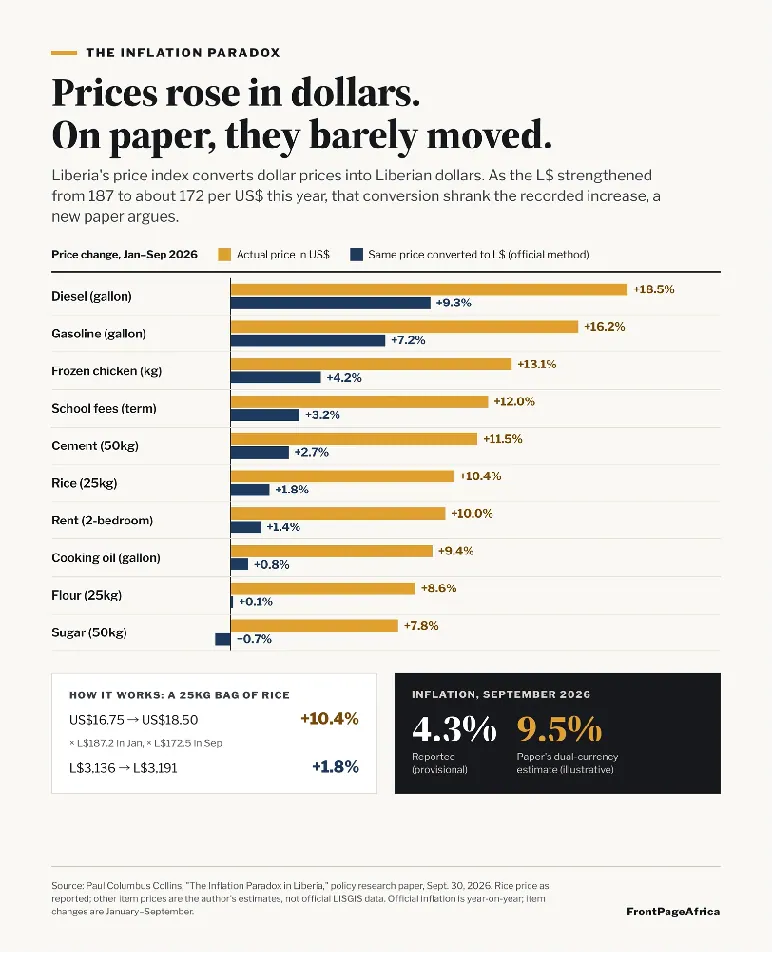
According to Dr. Collins, the steady fall in headline inflation reported by the Central Bank of Liberia (CBL) and the International Monetary Fund (IMF) is "not an economic anomaly but a measurement artifact." The paper cites a 25kg bag of rice rising from US$16.75 in January to US$18.50 in September, an increase of 10.4 percent. Other essential items, such as gasoline, diesel, cement, and cooking oil, also saw price increases.
The problem lies in how the Consumer Price Index (CPI) is put together. Many items in the basket are priced and paid for in US dollars, which are then converted into Liberian dollars at the going exchange rate before inflation is calculated. When the Liberian dollar gets stronger, each US dollar converts into fewer Liberian dollars, pulling the converted price down, even when the dollar price has gone up.
Dr. Collins estimates that inflation in September would stand at about 9.5 percent under his proposed method, more than double the roughly 4.3 percent produced by the current method. He argues that the distortion matters more in Liberia than almost anywhere else, given that the IMF has described Liberia as one of the most highly dollarized economies in the world.
The paper warns that the stronger the Liberian dollar becomes, the lower measured inflation will fall, regardless of what happens to real prices. This could push policymakers to ease monetary policy when they should not, as seen in the CBL's decision in July to cut its monetary policy rate to 16 percent. Dr. Collins proposes that Liberia measure inflation separately in each currency to get a more accurate picture.
Dr. Collins suggests that price collectors record whether each price was quoted in US or Liberian dollars, and that LISGIS calculate one inflation rate for US-dollar prices and another for Liberian-dollar prices. The official headline rate would be a weighted average of the two, based on how much of the economy runs in each currency. This approach would eliminate the impact of exchange-rate movements on inflation measurements.
The paper calls on LISGIS and the CBL to pilot the two-currency index using existing price surveys and publish both currency rates alongside the headline figure. It also urges the IMF to review Liberia's CPI method under its Extended Credit Facility program with the country. An accurate index is crucial for Liberia's standing in ECOWAS, which sets a regional inflation target of 5 percent or less.
Key points
- The true inflation rate in Liberia could be above 9 percent, contrary to the reported 4.3 percent.