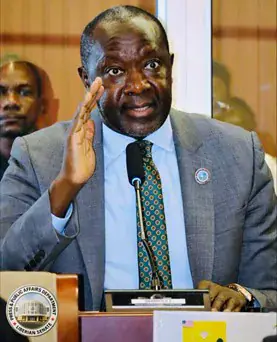
Liberian Senator Amara M. Konneh has cautioned the administration of President Joseph Nyuma Boakai that economic growth alone is insufficient, urging the President to reform the economy's structure and combat corruption. Konneh's warning comes after analyzing two major international reports: the World Bank's seventh Liberia Economic Update and the United States State Department's 2026 Investment Climate Statement on Liberia. Both reports, released in the last month, conclude that Liberia's growth has not translated to job creation and that corruption remains a significant barrier to investor confidence.
Konneh credits the Boakai administration for achieving macroeconomic stability, citing a 5.1% economic growth in 2025, up from 4.0% in 2024. The mining sector grew 17%, exports surged, and the budget deficit narrowed to 2.1% of gross domestic product (GDP). Additionally, debt fell to 55.1% of GDP, and inflation decreased. However, Konneh emphasizes that despite these positive indicators, the market remains unsatisfied, and people continue to complain about the lack of jobs and economic opportunities.
The World Bank report highlights concerning trends, including a rise in extreme poverty from 34.6% to 36.1% despite GDP growth. Furthermore, 78% of workers are engaged in informal self-employment, and 86% of firms are micro-enterprises. The agricultural sector, which employs most Liberians, grew only 2.6%, while capital spending was reduced from 8.5% to 5.7% of GDP. Konneh notes that these statistics indicate that the economy's growth has not been inclusive or beneficial to the majority of Liberians.
The United States State Department's assessment also identifies corruption as a major obstacle to investment in Liberia. According to Konneh, investors report demands for unofficial payments for permits, contracts, and customs clearance. The judiciary's weakness, with limited capacity and allegations of bribery, also hampers contract enforcement. Additionally, Liberia's infrastructure, including unreliable electricity, poor roads, and limited internet access, increases the cost of doing business.
Konneh stresses that investors are interested in Liberia, citing remarks by the U.S. Embassy's Chargé d'Affaires, Kristin Gilmore. However, Gilmore also emphasized that Liberia must provide investors with confidence to stay. Konneh argues that this confidence can only be achieved through structural reforms, including addressing corruption and improving governance.
Addressing President Boakai directly, Konneh insists that the international community is not criticizing Liberia but rather offering assistance to improve governance. He urges the President to take action against corruption and to appoint an enforcer who can provide honest feedback. Konneh warns that the ARREST Agenda for Inclusive Development will only succeed if the government transitions from stabilization to structural transformation and takes concrete anti-corruption measures.
Konneh concludes by emphasizing that Liberia's people are suffering, and the government's midterm performance has not alleviated their concerns. He urges President Boakai to take immediate action to address these issues, warning that failure to do so will undermine the credibility of the ARREST Agenda and the administration's overall performance.
Key points
- Corruption remains a significant barrier to investor confidence in Liberia.
- Liberia's economic growth has not translated to job creation or improved living standards for most citizens.
- The government must implement structural reforms to address corruption and improve governance to attract and retain investors.