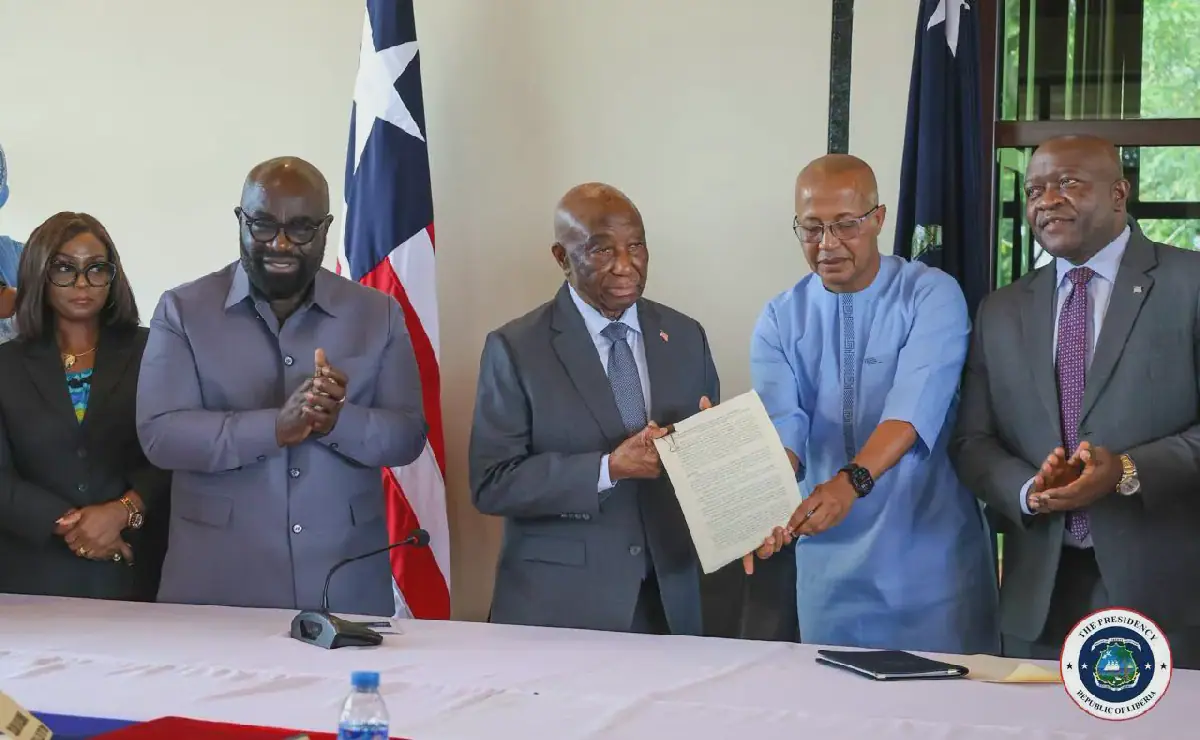
The Liberian government has launched the Master Infrastructure Development Agreement (MIDA), a comprehensive program aimed at transforming the country's infrastructure. The $5.45 billion initiative combines energy generation, transmission, roads, bridges, and national grid modernization in a single coordinated framework. The National Investment Commission (NIC) presented MIDA as the largest integrated infrastructure program ever conceived in Liberia. The program's goal is to address the country's long-standing infrastructure challenges and unlock its economic potential.
A key component of MIDA is the development of major hydroelectric and biomass facilities, including the 100-megawatt VIA Power Plant, the 100-megawatt SP-3 Hydropower Plant, and a 60-megawatt Biomass Power Plant. These projects aim to deliver clean, renewable, and sustainable electricity to support industrial expansion and improve the quality of life for millions of Liberians. The NIC emphasized that reliable electricity is essential for economic growth, enabling factories to operate efficiently, businesses to expand competitively, and hospitals to provide uninterrupted services.
One of the significant challenges addressed by MIDA is the country's dry-season power outages. The VIA dam, a crucial part of the program, will work like a giant water tank, holding almost 10 billion cubic meters of water. This water will be saved during the rainy season and released gradually during the dry season, ensuring a year-round supply of power from various hydropower plants. The NIC stated that this will enable Mount Coffee, the country's biggest power plant, to produce more power in the dry season with the same machines it has today.
The MIDA program also includes an extensive transmission system to ensure that electricity reaches where it is needed. The transmission system will comprise the Main Line, the Nimba Line, the Bong Line, and future national grid reinforcement investments. These corridors will strengthen energy security and extend economic opportunity beyond Monrovia, creating new possibilities for regional growth and industrial development across multiple counties.
In addition to energy and transmission, MIDA includes an ambitious transportation agenda that stretches across the country. The program covers several major road projects, including the Liberia Development Road, the Lofa Road and the Nimba Road, and the Coastal Highway system. The NIC emphasized that roads are the arteries of a nation's economy, and better roads will enable farmers to access markets, businesses to reduce transportation costs, and communities to connect to healthcare and public services.
The NIC highlighted that MIDA will have a significant impact on daily life in Liberia. Reliable, affordable power will bring steadier light at home, enable clinics and hospitals to keep their machines running, and allow children to study at night. The program will also provide cold storage for fish, meat, and produce, and enable small businesses to operate without the daily cost of fuel for generators. Big industry will also benefit from a stable power supply, leading to more jobs and economic growth.
The financing of MIDA is based on a gold-price windfall, ring-fenced from one mining company. This ties a five-year national program to one commodity and one firm. While the NIC is optimistic about the program's potential, Liberians will want to see the agreement itself, not just the vision. The government is seeking the support of Liberians for this sweeping bet, which promises to transform the country's infrastructure and economy.
Key points
- The MIDA program aims to end dry-season blackouts and boost Liberia's economy through a comprehensive infrastructure development plan.
- The program includes major hydroelectric and biomass facilities, as well as an extensive transmission system and transportation agenda.
- The financing of MIDA is based on a gold-price windfall from one mining company, tying a five-year national program to one commodity and one firm.