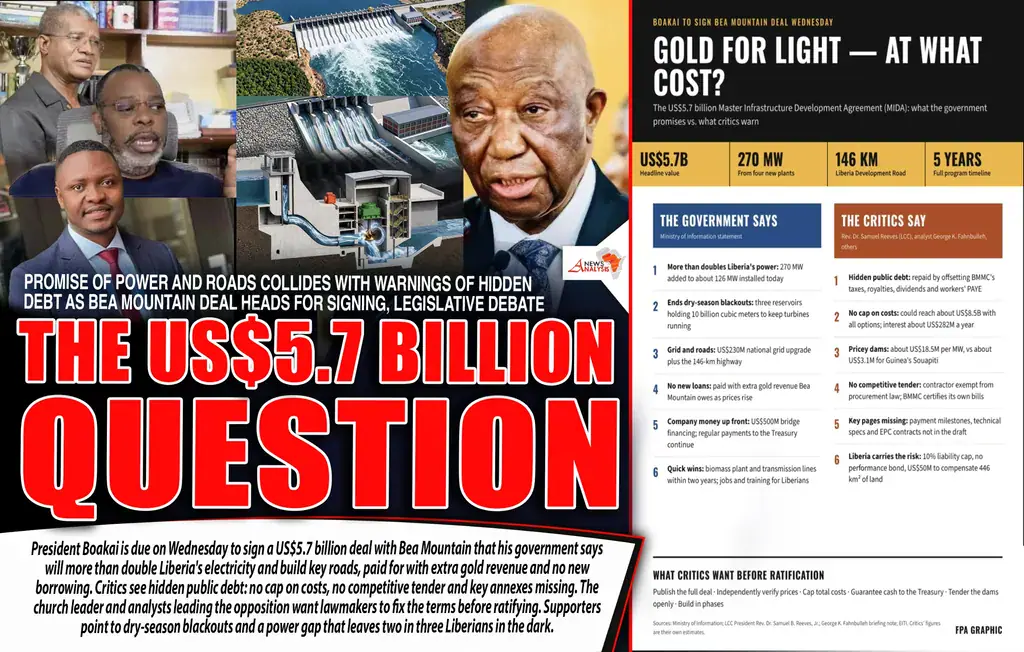
President Joseph Nyuma Boakai of Liberia is set to sign the Master Infrastructure Development Agreement (MIDA) with Bea Mountain Mining Corporation (BMMC), valued at approximately $5.7 billion. The agreement aims to address Liberia's persistent power shortages, with the goal of increasing the country's installed capacity from 126 MW to 270 MW through the construction of four new power plants. The deal also includes a commitment to upgrade substations, transformers, and transmission lines, as well as the development of the 146 km Liberia Development Road.
The MIDA agreement has sparked intense debate in Liberia, with critics warning that the country may be committing to unfavorable terms that could compromise its future gold income. Rev. Dr. Samuel B. Reeves, Jr., President of the Liberia Council of Churches, has urged the Legislature not to ratify the current version of the agreement, citing concerns over missing key documents, including payment milestones and technical specifications. Reeves estimates that the total cost of the project could exceed $5.6813 billion, with a potential additional ceiling of $2.23 billion.
Independent analyst George K. Fahnbulleh has also raised concerns over the repayment mechanism, describing it as "undisclosed public debt" that may not be accounted for in the national debt sustainability analysis. Fahnbulleh estimates that the interest on the debt could reach $282 million annually, while BMMC's payments to the government totaled $33.5 million in 2023. Critics argue that the arrangement could lead to a growing balance that would be passed on to future governments.
The deal has also faced criticism over the awarding of the contract, with concerns that the process was not transparent and that Bea Mountain Mining Corporation, a mining company rather than an infrastructure developer, was awarded the contract without competitive bidding. Columnist Seltue Robert Karweaye Sr. has questioned whether the deal is financed from Liberia's own future gold revenues rather than new foreign capital, arguing that it would be a commitment of public money rather than a generous investment.
Skepticism over the deal is also fueled by Bea Mountain's track record in Grand Cape Mount, where critics point to a gap between the mine's production and the state's revenue collection. According to the 16th EITI report, BMMC exported around 12,146 kilograms of gold worth over $653 million in fiscal year 2023. Both Grand Cape Mount senators have demanded renegotiation of the existing mineral agreement, citing concerns over the flat 3% royalty and tax payments.
The government has defended the deal, describing it as a "once-in-a-generation opportunity" that will be financed through innovative financing mechanisms, including ring-fencing additional revenue payable by BMMC. Officials claim that this approach will reduce Liberia's debt burden and provide a transformative catalyst for the nation's development. The agreement is expected to be ratified by the Legislature after it is signed by President Boakai.
The outcome of the debate remains uncertain, with lawmakers facing a critical decision on whether to ratify the agreement. Key points of contention include concerns over the repayment mechanism, the awarding of the contract, and the potential risks to Liberia's future gold income.
Key points
- The deal aims to increase Liberia's power generation capacity from 126 MW to 270 MW.
- Critics warn that the country may be committing to unfavorable terms that could compromise its future gold income.
- The agreement includes a commitment to upgrade substations, transformers, and transmission lines, as well as the development of the 146 km Liberia Development Road.