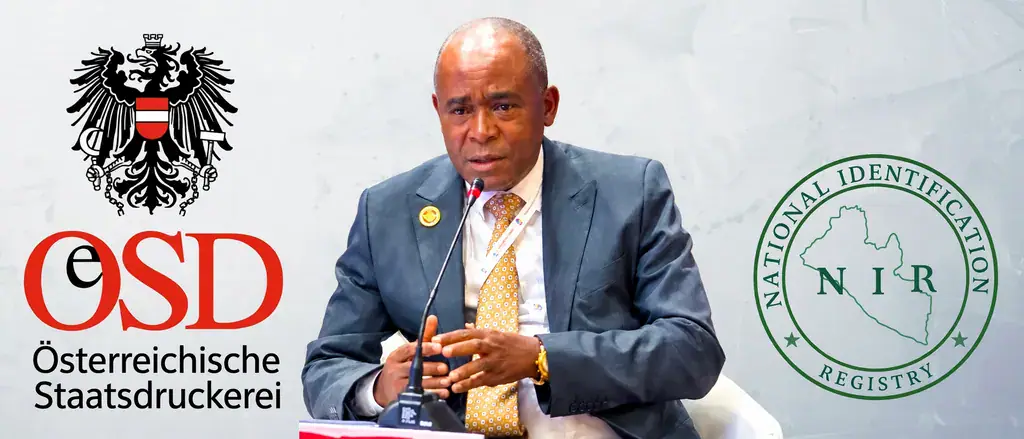
The Liberian government has rejected a US$54.7m national identification concession with OeSD International, an Austrian company, after the House of Representatives unanimously voted against the deal. The decision was made amid concerns over the firm's track record and financial capacity. The concession, which was proposed by President Joseph Nyuma Boakai, aimed to build, run, and earn from the country's most sensitive database for a decade.
OeSD International, a subsidiary of Österreichische Staatsdruckerei GmbH, was registered in Vienna in 2007 with share capital of just €35,000. The company's pitch to the Liberian government leaned heavily on its supposed "state" pedigree, which it no longer has, and on its parent company's reputation rather than its own balance sheet. The firm's proposal did not disclose whether the parent company or the holding company had guaranteed the commitment, or where the money would actually come from.
The Austrian company, whose name translates as "Austrian State Printing House", has been described as the "global arm of the Austrian State Printing Company" in Liberia. However, this is not the case, as Austria privatised the printer more than two decades ago. In 2000 and 2002, it was sold in two tranches for a combined €31 million to the Vienna private equity firm E.C.P. Capital Partners. Today, the same two men effectively control it through private foundations.
Despite its claims, OeSD International's experience in Africa is limited. In Ghana, the company developed and implemented a mobile app for membership registration and renewal, but it relies on an ID system built by someone else. In Nigeria, OeSD's personalisation software supports the ECOWAS National Biometric ID Card, but it was supplied through a prime contractor. The company's largest-scale experience is in printing and personalising documents for Austria, the European Union, Liechtenstein, and Andorra.
The US$54.7m Liberia concession would amount to well over half of OeSD International's entire group's annual revenue. The company's presentation to the National Identification Registry says it has more than 255 full-time employees plus 112 engineers "contracted exclusively" to its projects, serves "over 60 governments", and runs an Africa office in Accra, Ghana. However, these figures could not be independently verified.
The rejection of the concession highlights concerns over the procurement path and the company's financial capacity. The Liberian government's decision to reject the deal suggests that the country's leaders are cautious about entering into large-scale agreements with foreign companies. The country's national identification system is a critical infrastructure that requires careful consideration and due diligence.
The House of Representatives' unanimous rejection of the concession is a significant setback for OeSD International's plans in Liberia. The company's experience in Africa and its financial capacity have raised concerns among Liberian lawmakers. The country's national identification system will require a reliable and trustworthy partner to build and maintain, and the government will need to carefully consider its next steps.
Key points
- The Liberian government rejected a US$54.7m national identification concession with OeSD International due to concerns over the firm's track record and financial capacity.
- OeSD International's experience in Africa is limited, and its largest-scale experience is in printing and personalising documents for Austria, the European Union, Liechtenstein, and Andorra.
- The US$54.7m Liberia concession would amount to well over half of OeSD International's entire group's annual revenue.