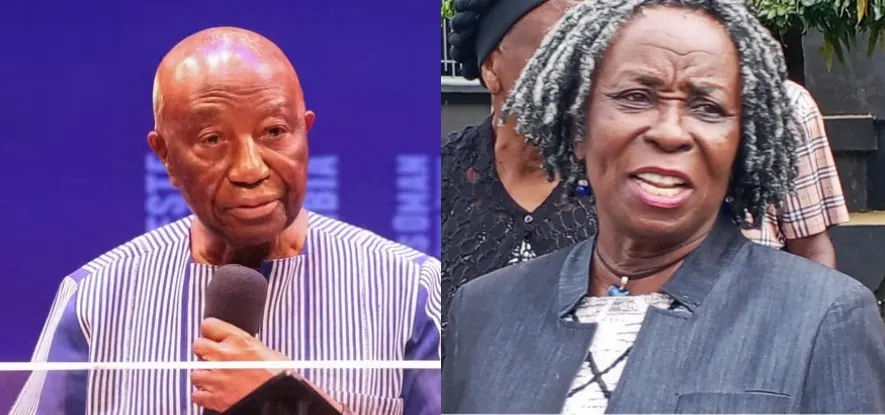
The ongoing trial of former Liberian officials, including Foreign Minister Dee-Maxwell Saah Kemayah, took a significant turn on Monday as former General Services Agency (GSA) Director-General Mary T. Broh testified before Criminal Court “C”. Broh, a subpoenaed defense witness, linked a letter from President Joseph Nyuma Boakai’s transition activities to a request for rice for young people working on a national cleanup campaign. Her testimony offered a different account from the prosecution’s theory that the movement and distribution of the Saudi-donated rice formed part of an unlawful scheme.
The Saudi donation consisted of 29,412 bags of 25-kilogram rice intended for disaster victims and vulnerable communities. Prosecutors allege that 25,054 bags, valued at approximately US$425,918, were unlawfully diverted or could not be accounted for. Broh’s testimony did not establish that President Boakai personally ordered the distribution of the Saudi rice. Rather, her account placed the transition-related cleanup campaign and Monrovia City Mayor John-Charuk Siafa’s appointment at the beginning of a chain of events through which rice was requested for “hungry cleanup campaign workers.”
Broh testified that Siafa approached her while coordinating the cleanup campaign associated with Boakai’s inauguration, showing her his appointment letter. She said the letter directed Siafa to contact her because she was considered a source of assistance for mobilization. Broh later became concerned when young people participating in the cleanup complained that they had nothing to eat. She contacted Siafa and instructed him to write the Ministry of Internal Affairs requesting rice. According to Broh, Siafa subsequently wrote then-Internal Affairs Minister Varney Sirleaf, after which rice was made available.
Broh also challenged the prosecution’s characterization of Kemayah’s involvement. She testified that Kemayah contacted her about the Saudi-funded rice and that a meeting was subsequently held at the GSA involving the Ministry of Foreign Affairs, Ministry of Internal Affairs, the National Disaster Management Agency (NDMA) and GSA. Broh characterized Kemayah’s intervention as an effort to “rescue” the rice. She maintained that the participation of Foreign Affairs, Internal Affairs, NDMA and GSA was part of an institutional effort to secure and manage the humanitarian commodity.
Broh defended the transfer of 13,895 bags of rice from NDMA to GSA, a movement that prosecutors have placed at the center of their case. She testified that it was agreed through an interagency mandate that the remaining Saudi rice be moved to GSA for storage until further notice. She also argued that GSA had a statutory responsibility to serve as custodian of government property and maintained warehouses for commodities and emergency supplies.
Broh stood by her earlier description of the indictment as “character assassination.” She maintained that officials were acting within their respective mandates to receive and distribute commodities based on requests. She also pointed to documents she said she provided to investigators, questioning why she would voluntarily turn over records that could help trace the rice if she intended to steal it. Former Deputy Minister of Internal Affairs Momolu Johnson also testified, challenging aspects of the prosecution’s accounting of the rice.
The case continues with Johnson’s testimony, which questioned how certain quantities were treated in the government’s case. The defense effort aims to challenge both the prosecution’s calculations and its theory of criminal intent. The indictment includes charges of theft of property, economic sabotage, misapplication of entrusted property, abuse of office, and criminal conspiracy against the defendants.
Key points
- President Boakai's name was mentioned in the Saudi rice trial as a letter from his transition activities was linked to a request for rice for a national cleanup campaign.
- Former GSA Director-General Mary T. Broh testified that the rice distribution was an institutional effort to secure and manage the humanitarian commodity.
- The case involves the alleged unlawful diversion of 25,054 bags of Saudi-donated rice, valued at approximately US$425,918.