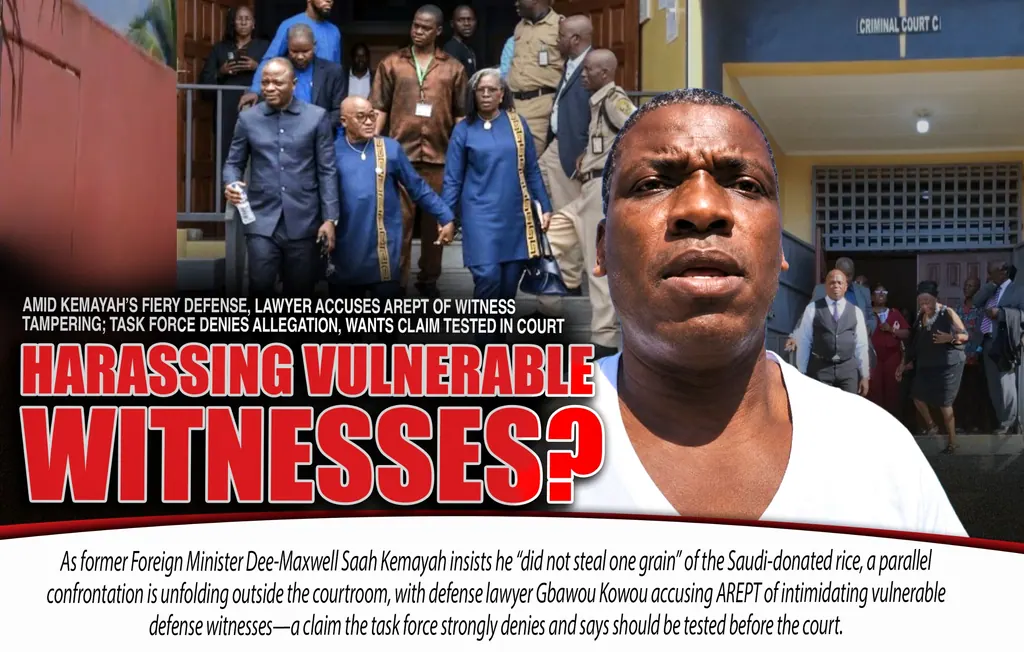
A confrontation outside the courtroom has opened a new front in the criminal trial of former Liberian officials accused of mishandling a Saudi-donated rice shipment. Defense lawyer Gbawou Kowou has accused the Asset Recovery and Property Retrieval Taskforce (AREPT) of intimidating or improperly engaging defense witnesses after they testified. The allegations were made during the trial of former Foreign Minister Dee-Maxwell Saah Kemayah, who is one of 13 former government officials accused of corruption-related offenses.
Kowou claimed that witnesses who had testified on behalf of Kemayah were pressured or threatened to report to AREPT following their appearance in court. The witnesses included members of the Group of 77 and members of the community of persons living with disabilities. AREPT has denied the allegations, stating that the witnesses were not summoned for questioning, were not interviewed, and were immediately asked to leave its premises after agency lawyers discovered that they had recently appeared in court as subpoenaed defense witnesses.
The dispute has raised questions over the treatment of witnesses in an ongoing criminal proceeding and whether witnesses who have already testified for the defense can be approached or brought to a prosecutorial agency without their lawyers being informed. AREPT's Public Relations Officer, Joseph F. Daniels, said the incident resulted from a misunderstanding rather than an attempt to interfere with testimony. According to AREPT, a potential witness who had previously provided a statement during the investigation was asked to appear at its office along with other persons familiar with the Saudi rice matter.
AREPT's lawyers did not initially know that the two individuals had recently appeared before Criminal Court "C" as defense witnesses. Upon recognizing them, AREPT lawyers immediately asked the two individuals to leave the premises. The agency stressed that the witnesses "were not invited by AREPT, were not interviewed, and no statement was taken from them." AREPT therefore rejected the accusation that its lawyers threatened, intimidated or attempted to influence the witnesses.
Kowou characterized the circumstances surrounding the witnesses' presence at the AREPT compound as serious, particularly because the individuals had already testified on behalf of the accused. The defense lawyer livestreamed a confrontation at AREPT's headquarters in Paynesville, demanding access to the compound. The confrontation eventually drew the attention of Liberia National Police officers, with Kowou continuing to insist that the matter involved possible interference with witnesses in an ongoing criminal proceeding.
The controversy is particularly sensitive because of the identity of some of the witnesses at the center of the dispute. Kowou said the witnesses were drawn from vulnerable and organized community groups and had appeared in court to give evidence for the accused. For the defense, the central issue is not simply whether AREPT lawyers spoke to the witnesses, but whether any contact occurred in circumstances capable of influencing, intimidating or otherwise affecting witnesses who had already placed their testimony on the official record.
The case involves 13 former government officials accused of corruption-related offenses arising from the handling of the Saudi-donated rice. The defense has consistently challenged the prosecution's interpretation of the documentary record, the quantity of rice received, the role of the National Disaster Management Agency, and the involvement of the General Services Agency. Former Foreign Minister Dee-Maxwell Saah Kemayah has delivered a forceful and emotional defense of his role in securing and managing the humanitarian rice project, stating that "I did not steal one grain of rice."
Key points
- AREPT denies allegations of witness tampering in the Saudi rice case.
- Defense lawyer Gbawou Kowou alleges that AREPT intimidated witnesses who testified for former Foreign Minister Dee-Maxwell Saah Kemayah.
- The controversy has raised questions over the treatment of witnesses in an ongoing criminal proceeding in Liberia.