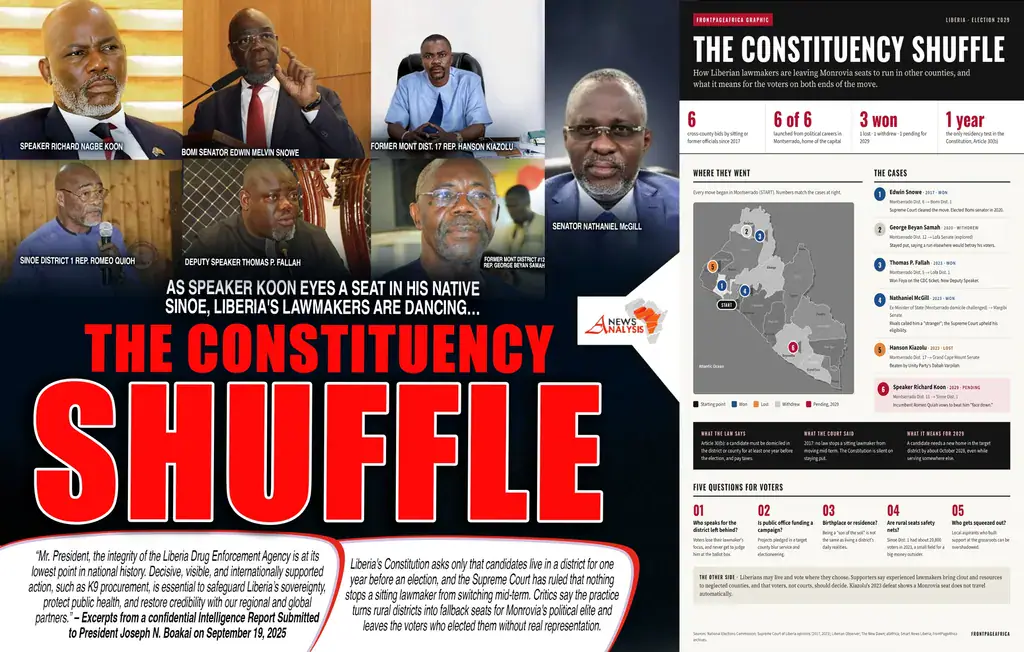
Liberia's Speaker of the House, Richard Nagbe Koon, has announced plans to represent his home county, Sinoe, in the 2029 elections, reigniting the debate over constituency hopping. Koon currently represents Electoral District #11 in Montserrado, where he was reelected in 2023 and elevated to the speakership the following year. However, he was born in Sinoe and has signaled his intention to represent his home county in the future. This move has sparked concerns among citizens and lawmakers about the implications of constituency hopping.
Koon's decision is not unprecedented. Edwin Melvin Snowe Jr., a former Speaker, paved the way for this move in 2017 when he registered as a voter in Senjeh, in Bomi County, and announced his candidacy for Bomi's District #1 seat. The move was blocked by Bomi's political establishment, but the Supreme Court ruled in his favor, stating that no law forbids a sitting representative from changing his domicile to another county while still serving the one that elected him. Snowe went on to win the Bomi seat and later a Senate seat representing the whole county.
Since Snowe's move, others have followed in his footsteps. Thomas P. Fallah, a long-serving representative for Montserrado's District #5, headed to Lofa County in 2023 and won District #1, becoming Deputy Speaker of the House. Nathaniel McGill, a former Minister of State for Presidential Affairs, sought a Senate seat in Margibi County, but faced opposition from citizens who accused him of falsely swearing that he lived in Margibi. Despite this, the Supreme Court upheld his eligibility, and Margibi voters elected him.
However, not every attempt at constituency hopping has been successful. Hanson Kiazolu, who represented Montserrado's District #17, ran for the Senate in Grand Cape Mount County in 2023 but lost to Dabah Varpilah of the Unity Party. Some of his Monrovia constituents complained that he was walking away from them. George Beyan Samah, of Montserrado's District #12, publicly explored a Senate run in Lofa in 2020 but stepped back, saying that spending his resources campaigning elsewhere would betray the people who had trusted him with their votes.
Liberia's rules on constituency hopping are remarkably light. Article 30(b) of the 1986 Constitution requires anyone seeking a seat in the Legislature to have been domiciled in the county or district they want to represent for at least one year before the election and to be a taxpayer. However, the Constitution says nothing about whether a lawmaker must keep living in the district through his term or whether he may campaign or channel resources elsewhere while still drawing a salary to represent his current voters.
The trend of constituency hopping raises uncomfortable questions for voters. The first concern is the district left behind. If Koon's attention shifts to Sinoe, his current constituents in Montserrado's District #11 will be left with a representative in name only. They will also lose the opportunity to vote him in or out again, as he will not be on their ballot. The second concern is the blurred line between office and campaign. When Koon makes promises in Sinoe, voters wonder whether they are hearing a commitment from the Legislature or the opening pitch of a campaign.
The debate over constituency hopping highlights the need for clearer rules and regulations. Some citizens think the bar is too low, and during consultations on electoral reform, residents of Grand Cape Mount called for the residency requirement to be doubled to two years. As the trend of constituency hopping continues, Liberians will be watching closely to see how it affects their representation and the country's democratic institutions.
Key points
- Speaker Koon's plan to represent Sinoe in 2029 has sparked debate over constituency hopping.
- Liberia's rules on constituency hopping are remarkably light, with only a one-year residency requirement.
- The trend of constituency hopping raises concerns about the district left behind and the blurred line between office and campaign.