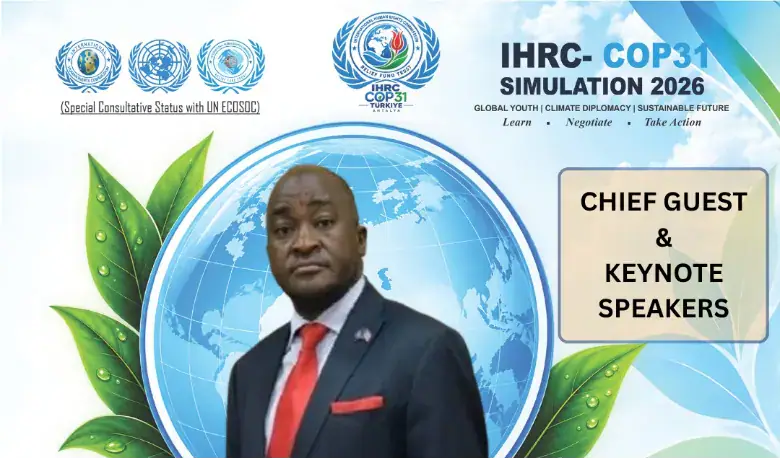
Former Foreign Minister Dee-Maxwell Saah Kemayah Sr. of Liberia has urged governments and international institutions to give young people a more meaningful role in climate negotiations, policymaking, and implementation. Speaking at the International Human Rights Commission (IHRC)-COP31 Simulation Conference 2026, Kemayah emphasized that young people must be recognized as active partners in addressing climate change, rather than just future leaders who will inherit its consequences. He made the remarks during a two-day online conference that brought together students, young professionals, diplomats, scholars, and civil society representatives.
The conference, themed "Global Youth, Climate Diplomacy, and a Sustainable Future," aimed to explore international climate negotiations and the challenges of reaching agreements on climate finance, technology transfer, energy security, and climate-related displacement. Kemayah, who served as Liberia's Minister of Foreign Affairs and Dean of the Cabinet, noted that climate change has evolved beyond an environmental concern into a global development challenge affecting food security, public health, livelihoods, economic growth, and human dignity. He quoted former United Nations Secretary-General Ban Ki-moon, reminding delegates that "there is no Plan B because there is no Planet B."
Kemayah emphasized the challenges facing developing countries, which must confront climate vulnerability while struggling with poverty, unemployment, inadequate infrastructure, and limited financial resources. He cited changing rainfall patterns, droughts, coastal erosion, flooding, and extreme weather events as threats to agricultural productivity, infrastructure, water supplies, and public health systems. For vulnerable countries, responding effectively to climate change requires more than commitments to reduce greenhouse gas emissions; it also demands adequate financing, access to technology, stronger adaptation programs, and international cooperation.
Kemayah highlighted the principles of equity and common but differentiated responsibilities and respective capabilities under the international climate framework, including the Paris Agreement. These principles recognize that countries differ in their historical contributions to greenhouse gas emissions, financial and technological capacity, and exposure to climate risks. He argued that a fair international response must combine environmental ambition with development needs, emphasizing that climate justice should provide vulnerable countries with a realistic pathway toward sustainable development.
A central theme of Kemayah's address was the gap between inviting young people to climate conferences and giving them the power and resources to influence decisions. He identified young people as researchers, entrepreneurs, community organizers, technical professionals, and emerging diplomats whose contributions could strengthen climate planning and implementation. University students could investigate local climate risks, while young entrepreneurs could develop renewable-energy solutions and sustainable businesses.
Kemayah challenged governments to measure the success of climate diplomacy by tangible outcomes rather than the number of declarations signed or promises announced. He outlined four essential requirements for effective climate negotiations: sustained dialogue and mutual understanding, credible scientific evidence, equity in international cooperation, and stronger implementation and accountability mechanisms. The ultimate test, he said, should be whether agreements produce cleaner energy, stronger climate resilience, protected ecosystems, effective adaptation, and improved access to climate finance.
To translate climate commitments into practical results, Kemayah proposed five strategic priorities for governments, educational institutions, development partners, and young people. The priorities include strengthening climate education and research, promoting youth-led climate action, and providing young people with access to information, technical training, mentorship, financing, and opportunities to participate in national climate consultations and international negotiations. By taking a more active role in climate decision-making, young people can help shape a more sustainable future.
Key points
- Former Liberian Foreign Minister Dee-Maxwell Saah Kemayah Sr. calls for global youth to take a more active role in climate negotiations and policymaking.
- Kemayah emphasizes the need for a fair international response to climate change that combines environmental ambition with development needs.
- He proposes five strategic priorities for governments, educational institutions, development partners, and young people to translate climate commitments into practical results.