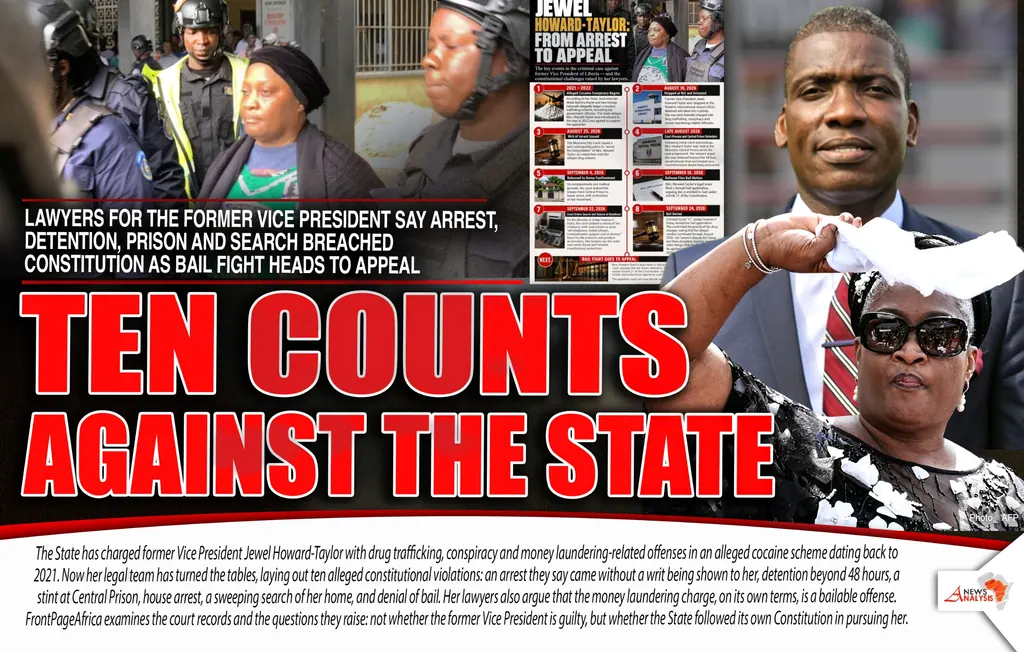
In a significant development in Liberia's recent history, former Vice President Jewel Howard-Taylor has been placed under house arrest, with her bail application denied. Her lawyers have raised concerns about the constitutionality of her arrest, detention, and imprisonment. According to her legal team, nearly every step taken by the State against her has breached the Constitution. The allegations against her remain unproven, and both the State's claims and her lawyers' assertions will be tested in court.
The government's case against Howard-Taylor centers on allegations that she was involved in a cocaine importation and exportation scheme. The State claims that in 2021, businessman Sheik Bashiru Kante brought two foreign nationals to Liberia, who allegedly conspired to import and export cocaine through Liberia to Europe. The State alleges that Howard-Taylor was recruited to protect the scheme and received payments from the cartel. She is charged under various laws, including the Controlled Drugs and Substances Act of 2023 and the AML-CFT Act of 2021.
Howard-Taylor's lawyers have identified ten separate points at which they claim her liberty was taken or restricted without full regard to the safeguards in Article 21 of the 1986 Constitution. These include arrest without presentation of a writ of arrest, incarceration beyond 48 hours, failure to formally charge and present her before a court within 48 hours, and absence of an indictment at the relevant stage. Her lawyers argue that these actions constitute a "cumulative constitutional injury."
A critical aspect of the defense argument is Article 21 of the Constitution, which requires that anyone arrested be formally charged and presented before a court of competent jurisdiction within 48 hours. The legal team contends that the records show Howard-Taylor was held beyond that window before the required judicial process was completed. The 48-hour rule is not discretionary, and if the chronology holds up, it would be a straightforward constitutional question in the case.
The defense's claims are echoed in a court interim order dated September 22, 2026, which describes Howard-Taylor as "currently being detained while undergoing investigation by National Joint Security authorities." This language suggests that the investigation was still underway while she was held, which her lawyers argue does not justify continued detention, particularly under a Constitution that expressly bars preventive detention.
Howard-Taylor's journey from arrest to the Monrovia Central Prison and then to house arrest forms another pillar of the defense case. Her lawyers argue that the Constitution protects accused persons from being treated as convicted prisoners and that housing an unconvicted former Vice President at the country's main penitentiary raises questions about both the legal basis for her confinement and the conditions she faced. The later move to house arrest is itself a restriction on constitutionally protected freedom of movement.
The search of Howard-Taylor's home has also sparked controversy. A court order directed the Sheriff of Criminal Court "C" to conduct a "comprehensive inspection" and seize "all telephones, mobile phones, communication gadgets and/or devices" found on the premises or in her possession. The defense argues that officers removed not only Howard-Taylor's devices but also those belonging to other people, raising questions about the breadth of the order and whether it meets constitutional standards.
Key points
- The case against Howard-Taylor centers on allegations of cocaine importation and exportation.
- Her lawyers claim that her arrest, detention, and imprisonment breached the Constitution.
- The bail question may prove decisive in determining the outcome of the case.