In Kpolokplah Town, deep in Bong County District Two, the school year has been suspended due to a debt of a few thousand Liberian dollars that a struggling farming community cannot pay. The Kpolokplah Public School relied entirely on volunteer teachers since the government never assigned staff, leaving the Parent-Teacher Association (PTA) to fund salaries through farming and charcoal sales.
A failed harvest cut this income, and teachers went unpaid for six months, leading to a strike that closed the school. The government response has focused elsewhere, leaving the crisis unresolved. The school's principal, Jeremiah D. Yarkpawolo, revealed that the school has no government-assigned teachers, and every instructor has been a volunteer recruited, retained, and paid by the community's PTA.
The PTA was not merely supplementing the school's teaching staff; it was the entire staffing infrastructure, quietly substituting for a state responsibility that never arrived. When that substitute system broke down, there was nothing behind it to catch the fall. The economics behind the crisis are almost painfully modest, with each of the four volunteer teachers owed just LD$5,000 a month for six months.
The community turned to farming, charcoal-making, and small trades to funnel proceeds toward teacher salaries in a grassroots, informal payroll system. However, this year's farming season faltered, yields dropped, and the trickle of income the PTA depended on dried up along with it. The town's current struggles do not exist in isolation from its past, carrying the weight of Liberia's civil war within its history.
For a community that has already endured such loss, the slow erosion of its children's access to education represents not just a present-day crisis but another entry in a long history of hardship that seems to have outlasted the war itself. Residents see the school closure as part of a broader pattern, where promises of post-conflict rebuilding and development have been slow to reach communities like theirs.
Hon. James M. Kolleh, Representative for Bong County Electoral District 2, has publicly acknowledged the education and water challenges facing communities under his watch. His response has focused heavily on Barsee Kpangbai Public School in Blemeyea, which reportedly operates with just two teachers for its entire student body. Rep. Kolleh has pledged to work toward deploying two additional teachers to the school.
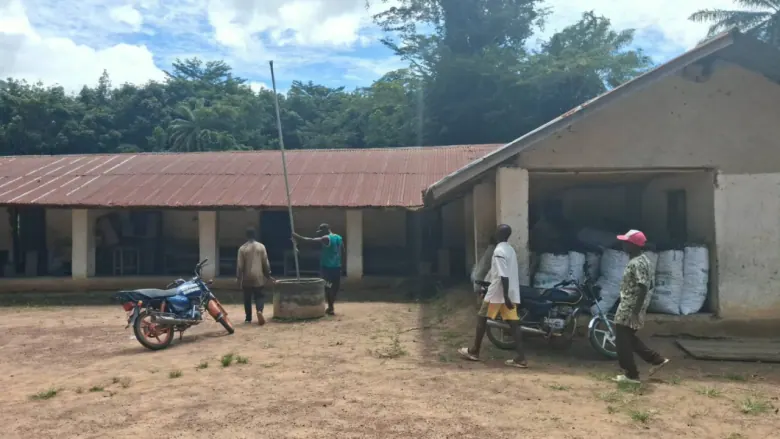
The school building has quietly taken on a new identity, a storage site for charcoal, the same commodity residents are burning and selling in a desperate bid to raise the money needed to reopen the school. The classrooms meant to hold desks, chalkboards, and children now hold sacks of fuel bound for market. There is a bitter symmetry to this image that is hard to ignore.
Key points
- The failed harvest has led to a debt of a few thousand Liberian dollars that a struggling farming community cannot pay.
- The school's reliance on volunteer teachers and community funding has left it vulnerable to financial shocks.
- The government response to the crisis has been limited, leaving the community to find its own solutions.