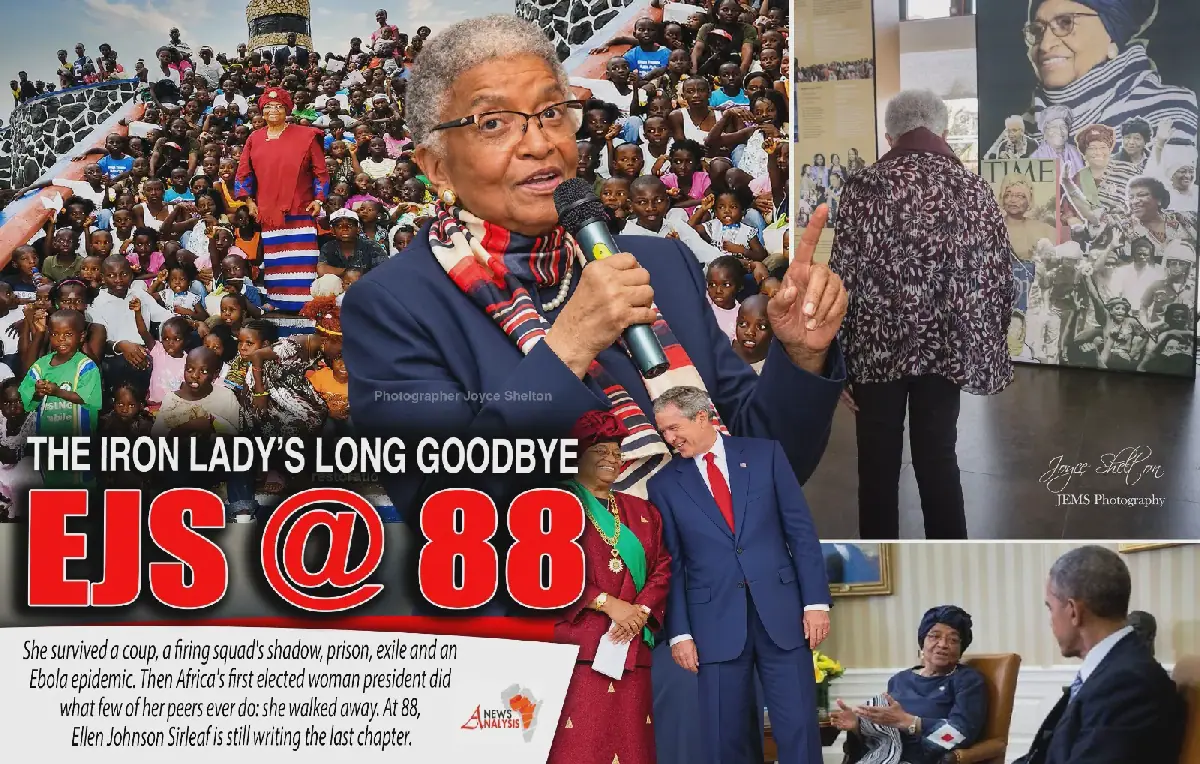
Today, October 29, Ellen Johnson Sirleaf, known as Africa's "Iron Lady," celebrates her 88th birthday. Her life story is deeply intertwined with Liberia's modern history. Born in 1938 in Monrovia, Sirleaf's family background reflected the country's complex social structure. Her father, Jahmale Carney Johnson, was the son of a Gola chief and became one of the first indigenous Liberians in the national legislature. Her mother was a teacher and preacher of mixed Kru and German heritage.
Sirleaf's early life and education set her on a path that would take her from a Monrovia schoolgirl to a global figure. She attended Monrovia's College of West Africa and later moved to the United States, where she studied accounting at Madison Business College in Wisconsin and earned a master's in public administration at Harvard's Kennedy School. In 1961, she left Liberia with her husband, James Sirleaf, and their four young sons. Her time in the U.S. equipped her with skills that she would later use to serve Liberia.
Upon her return to Liberia, Sirleaf joined the Treasury and quickly gained a reputation for her outspoken nature. In 1969, she delivered a speech criticizing corruption and economic mismanagement, which was risky in the one-party state of President William Tubman. Under President William Tolbert, she rose to become Liberia's finance minister in 1979. However, her tenure was short-lived as Master Sergeant Samuel Doe and a band of soldiers stormed the Executive Mansion and killed Tolbert in April 1980.
Sirleaf's confrontation with Doe's regime led to her exile. She worked for Citibank in Nairobi and the World Bank but returned to Liberia in 1985. Her criticism of Doe's regime led to a 10-year sentence for sedition, though international pressure secured her release. She was arrested again after a failed coup and held for months, during which she faced threats of rape by a soldier in her cell. This period marked a significant challenge in her life and career.
In 2005, Sirleaf made a significant comeback by winning the presidential election with about 59 percent of the vote in a runoff against George Weah. She was sworn in as the first woman elected to lead an African nation. Her government focused on rebuilding Liberia, which was in a state of ruin after years of civil war. She used her connections in Washington to secure aid and investments, leading to improvements such as the return of electricity to parts of Monrovia and the reopening of schools.
Sirleaf's presidency was marked by significant achievements, including the cancellation of about $4.6 billion of Liberia's debt by creditors in 2010. She also played a role in international affairs, advocating for the trial of Charles Taylor, who was accused of war crimes, to be held in The Hague. In 2011, she was awarded the Nobel Peace Prize for her non-violent struggle for women's safety and their full participation in peace-building. However, her legacy was also complicated by criticisms, including her early support for Taylor and allegations of nepotism.
Despite the challenges and criticisms, Sirleaf's impact on Liberia and her role as a symbol of hope and change for many Africans remain significant. Her life story, from her early days as a schoolgirl in Monrovia to her presidency and Nobel laureate, reflects both the progress and the unfinished business of Liberia. As she turns 88, her legacy continues to be a subject of reflection and discussion, both within Liberia and internationally.
Key points
- Ellen Johnson Sirleaf turns 88, marking a life that mirrored Liberia's modern history.
- Sirleaf was the first woman elected to lead an African nation, serving as Liberia's president from 2006 to 2018.
- Her legacy is complex, marked by achievements such as debt cancellation and Nobel Peace Prize, but also criticized for early support of warlord Charles Taylor and allegations of nepotism.