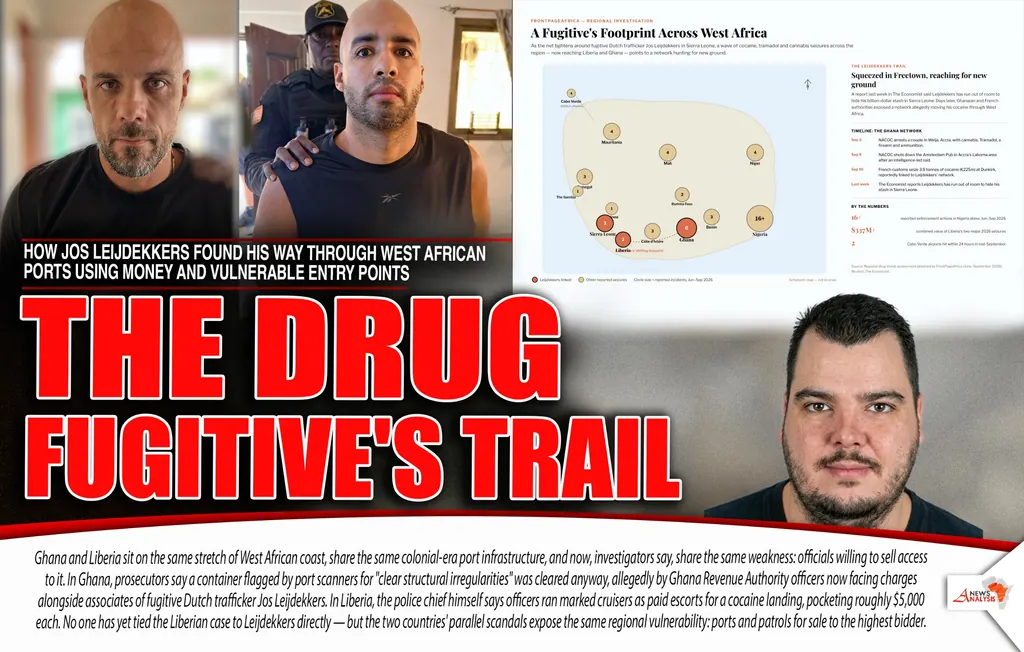
A recent investigation has revealed a widespread corruption network in West Africa's ports, enabling drug traffickers to smuggle large quantities of narcotics through the region. In Ghana, prosecutors have charged several officials, including three Ghana Revenue Authority officers, with taking bribes to clear a shipment of 3.9 tonnes of cocaine from the port of Tema. The shipment, worth an estimated $261 million, was flagged by port scanners for "clear structural irregularities" but was cleared for release anyway.
The corruption network appears to be widespread, with similar cases emerging in Liberia. The Liberian police chief, Inspector General Gregory Coleman, has confirmed that Liberian National Police officers actively helped move roughly four tons of cocaine, with some officers receiving $5,000 each for their services. Two names have surfaced in connection with the Liberian case: Wadell W. Kwarbo, chief of the Highway Patrol Section, and Anthony T. Blaye, chief of the Financial Crime Division.
While the Liberian case has not been directly linked to the Dutch fugitive Jos Leijdekkers, the pattern of corruption in both countries suggests a larger regional vulnerability. Leijdekkers, reportedly sheltering in Sierra Leone, is suspected of being involved in a network that has been moving large quantities of narcotics through West Africa's ports. In Ghana, four individuals have been arraigned for allegedly representing and facilitating Leijdekkers' activities.
The investigation has also revealed a connection between Ghana and Liberia, with Liberian officials confirming that one of the foreign nationals in custody carries a Ghanaian passport and a residence permit issued under two different names. This suggests that the corruption network may be more extensive than initially thought, with individuals using fake documents to move through the region.
The Ghanaian government has responded to the allegations, with MP Ntim Fordjour calling for a parliamentary probe into the country's emergence as a "cocaine coast." The presidency has ordered inter-agency investigations and restored the Narcotics Control Commission's mandatory role in screening port cargo. In Liberia, the police chief has confirmed that several officers are facing disciplinary action for their involvement in the corruption network.
The investigation has also highlighted the use of fake documents by individuals involved in the corruption network. Liberian authorities have confirmed that most of the Eastern Europeans moving through these networks are based in Accra and carry Ghanaian passports, some of which may be fake. This has raised concerns about the security of the region's ports and the need for greater cooperation between countries to combat drug trafficking.
The cases in Ghana and Liberia demonstrate a clear vulnerability in West Africa's ports, with officials allegedly taking bribes to allow drug shipments to pass through. The international community has called for greater cooperation and action to combat drug trafficking in the region.
Key points
- Corruption in West Africa's ports enables drug traffickers to smuggle large quantities of narcotics through the region.
- Officials in Ghana and Liberia have been accused of taking bribes to clear drug shipments.
- The cases in Ghana and Liberia highlight the need for greater cooperation between countries to combat drug trafficking.