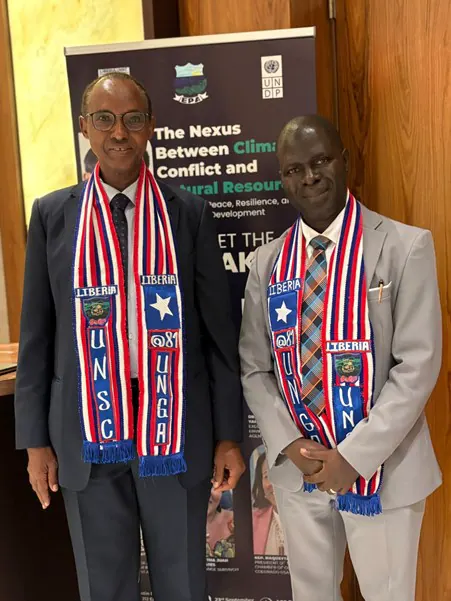
Liberia has taken a proactive stance on the issue of climate change and security, using its current seat on the United Nations Security Council to emphasize the far-reaching consequences of a warming world. The Environmental Protection Agency (EPA) of Liberia recently hosted a high-level side event in New York, bringing together international leaders and experts to discuss the links between climate change, conflict, and natural resources. The event, titled "The Nexus between Climate, Conflict, and Natural Resources: Pathways to Peace, Resilience, and Sustainable Development," aimed to shed light on the complex relationships between these issues.
The EPA's Executive Director, Dr. Emmanuel K. Urey Yarkpawolo, welcomed participants and emphasized that climate change acts as a threat multiplier, exacerbating poverty, food insecurity, displacement, and competition over essential resources. He noted that Liberia's own history, including its civil wars fueled by the exploitation of timber and diamonds, underscores the importance of addressing these issues. Yarkpawolo stressed that peace is one of Liberia's greatest achievements, but sustaining it requires addressing emerging environmental and economic risks.
The event featured a keynote address by UN Under-Secretary-General and UNDP Associate Administrator Haoliang Xu, who highlighted the need for coordinated action to address climate-related security risks. Foreign Minister Sara Beysolow Nyanti, also Dean of the Cabinet, formally opened the event and set out its objectives. The discussion was moderated by Francine Pickup, UNDP Deputy Assistant Administrator. The panel included experts from various fields, including Daniel Kandy, a board member of Mighty Earth, and Ambassador Dr. Ali Daud Mohamed, Kenya's Special Envoy for Climate Change.
The panelists emphasized that climate change can deepen poverty, displacement, inequality, and competition over natural resources, ultimately contributing to tension and instability. They also highlighted the importance of integrating climate action into peacebuilding efforts and ensuring that climate finance reaches communities that protect forests, biodiversity, and other natural assets. The discussion also touched on the role of carbon markets and climate finance in producing measurable community benefits while protecting environmental integrity and public confidence.
Liberia's commitment to addressing climate-related security risks is reflected in its Council agenda. Yarkpawolo emphasized that the country aims to identify practical solutions, mobilize partnerships, and advance recommendations that governments, partners, investors, and communities can implement. The goal is to strengthen support for adaptation, forest and biodiversity conservation, resilient livelihoods, transparent resource governance, and locally led peacebuilding.
The climate-security agenda remains a contested issue at the UN Security Council, with some countries, including Russia, vetoing draft resolutions that would integrate climate-related security risks into the Council's work. However, Liberia's efforts to raise awareness and promote action on this issue have garnered support from various stakeholders, including climate-change survivors, who shared their personal experiences and highlighted the human impact of climate change.
The outcome of the side event is expected to guide partnerships and inform future action on climate-related security risks. The EPA has promised an outcome summary that will provide a roadmap for addressing these issues. Key points from the discussion include: climate change acts as a threat multiplier, exacerbating poverty, displacement, and competition over resources; climate action must be integrated into peacebuilding efforts; and climate finance must reach communities that protect forests, biodiversity, and other natural assets.
Key points
- Climate change acts as a threat multiplier, exacerbating poverty, displacement, and competition over resources.
- Climate action must be integrated into peacebuilding efforts.
- Climate finance must reach communities that protect forests, biodiversity, and other natural assets.