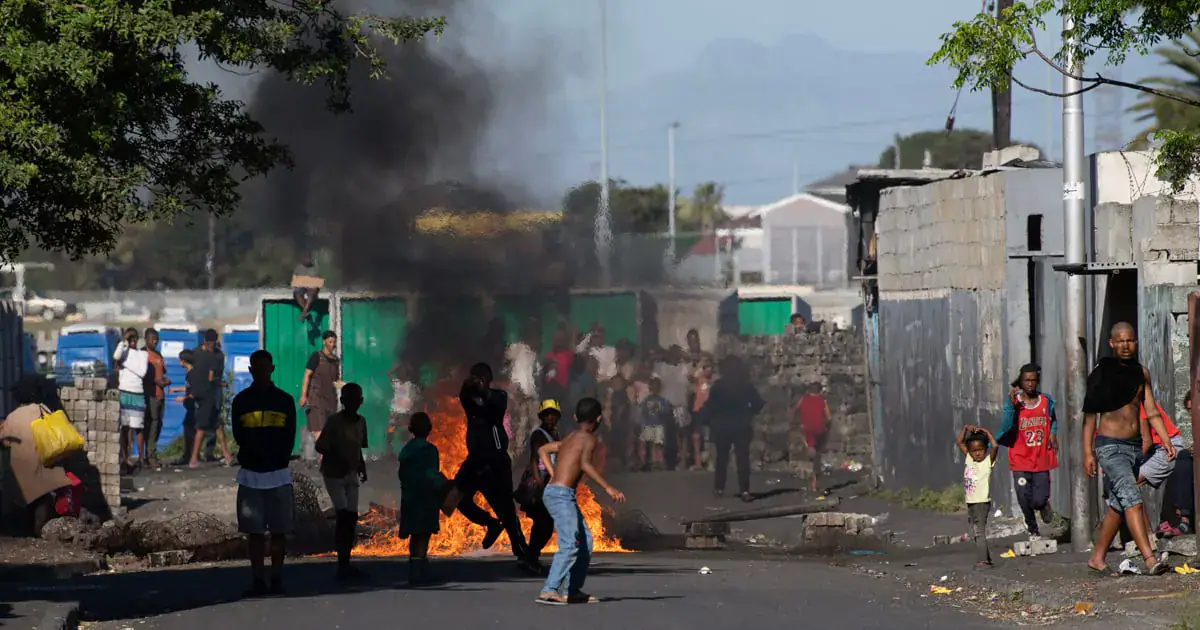
South Africa is set to hold its local government elections on November 4, with over 29 million people registered to vote. The polls are seen as a crucial test of the country's democratic system and may signal a shift in political loyalties. The elections come amid growing frustration with local government failures, particularly in the delivery of basic services such as water, power, and sanitation. Many residents in deprived townships, such as Khayelitsha in Cape Town, live in informal shacks with no access to proper sanitation.
The lack of basic services is a major concern for many voters, including Ntombekhaya Makeleni, a 53-year-old resident of Khayelitsha. She stopped using communal toilets in her neighborhood after a group of men tried to force their way in and now relies on a bucket that is emptied outside later. Makeleni plans to vote in the elections, saying, "I will be voting because after voting, things will be fixed." Her experience is not unique, with many residents in similar situations.
The African National Congress (ANC), which has dominated South African politics since the end of apartheid, is facing growing competition from other parties. The ANC slid under the 50-percent threshold in the 2021 local elections and lost its national parliamentary majority in 2024. The Democratic Alliance (DA), the second-largest party, is running a determined campaign in Johannesburg, highlighting the failures of the ANC-led council. The DA already governs Cape Town and is seeking to expand its influence.
The local government elections are also being influenced by the growing fragmentation of the political landscape. Over 500 parties are registered with the electoral commission, reflecting a highly competitive and diverse field. An Ipsos survey published in March found that nearly half of South Africans felt no political party represented their views, while only 38 percent believed their municipality was doing its job well. This disillusionment may impact voter turnout and the overall outcome of the elections.
Voter turnout will be a key factor in the elections, with only 46 percent of registered voters casting ballots in the 2021 local elections. The results are likely to reinforce the trend towards coalition governments and test whether they can produce stable local councils. Since the last municipal elections, no party has been able to hold a majority in just under a third of the 257 councils. The formation of coalitions may lead to more stable governance, but it also increases the risk of political instability.
The elections are also being influenced by the emergence of new parties, including the MK party led by ex-president Jacob Zuma. The MK party secured third place in the previous national polls and is now contesting the local government elections. For some younger South Africans, such as Ntokozo Mthethwa, a 21-year-old IT student from Durban, voting seems pointless. Mthethwa expressed doubts about the ability of any party to deliver on its promises, saying, "I see no future for me here."
The local government elections will provide insight into the state of South African democracy and the evolving political landscape. The outcome will depend on various factors, including voter turnout, the performance of traditional parties, and the emergence of new players. The elections will also highlight the ongoing challenges facing the country, particularly in the delivery of basic services and the fight against unemployment, which stands at 33 percent.
Key points
- The lack of basic services such as water, power, and sanitation is a major concern for many voters.
- The ANC is facing growing competition from other parties, including the DA and the MK party.
- Voter turnout and the formation of coalitions will be key factors in determining the outcome of the elections.