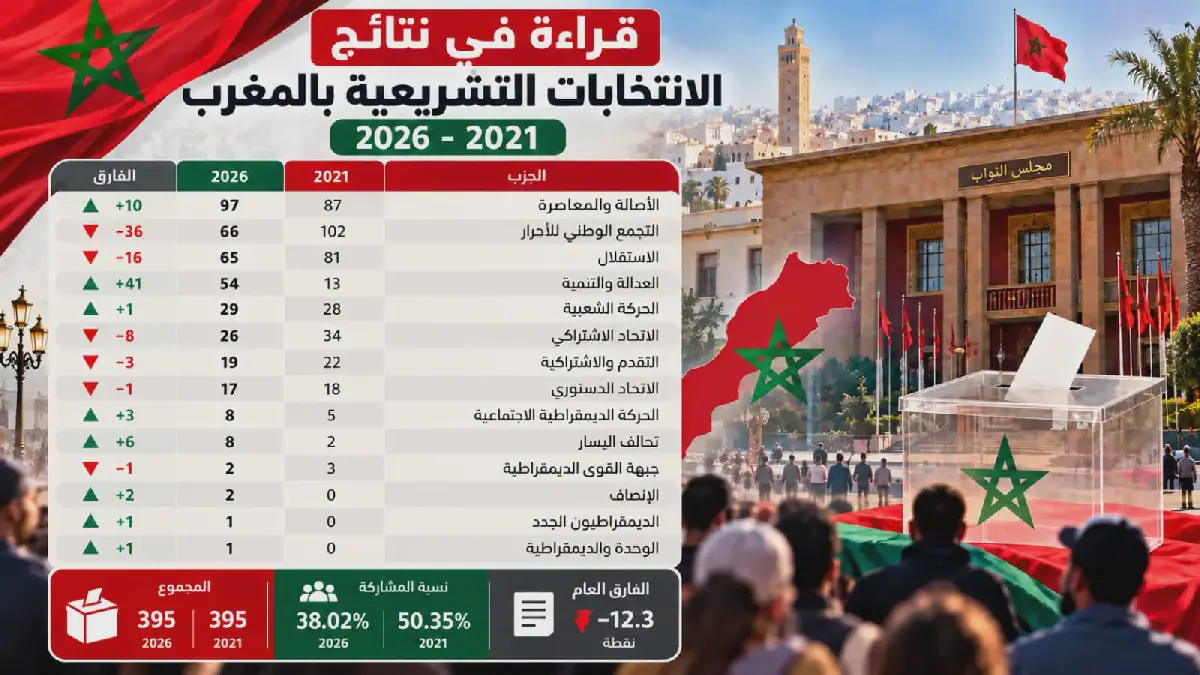
Morocco's 2026 legislative elections have produced a new party map, diverging from the 2021 results, amid a decline in voter turnout and what some observers describe as "punitive voting." This shift has led to a redistribution of electoral power among parties. The National Rally of Independents was among the most affected, dropping from 102 seats in 2021 to 66 seats in 2026. Analysts attribute this decline to the party's leadership of the previous government, making it accountable for the period's outcomes.
In contrast, the Justice and Development Party achieved a notable surge, increasing its seats from 13 to 54. The Authenticity and Modernity Party also saw gains, rising from 87 to 97 seats. The Independence Party moved in the opposite direction, dropping from 81 to 65 seats. The Socialist Union of Popular Forces experienced a decline, from 34 to 26 seats, which some attribute to its perceived ambiguous political stance. This unclear positioning may have affected its image among some voters.
The Progress and Socialism Party's decline from 22 to 19 seats was a surprise to some observers who had anticipated its growth. Analysts cite the party's leadership performance over the past five years as a contributing factor. Conversely, the Popular Movement maintained its presence, increasing its seats from 28 to 29. This stability is seen as a positive indicator of the party's current leadership under Mohamed Ouzine.
The Leftist Alliance made significant gains, rising from 2 to 8 seats. This increase is attributed to the political presence of Jamal Asri and his campaign rhetoric during the election period. Other parties, such as the Social Democratic Movement, saw an increase from 5 to 8 seats, while the Constitutional Union dropped from 18 to 17 seats. The Democratic Left and the Justice and Development Party also experienced changes, with the former dropping to 2 seats and the latter gaining prominence.
The elections also saw the emergence of new parties, including the Equity Party with 2 seats, and the New Democrats and Unity and Democracy, each securing one seat. These shifts in the party landscape raise questions about the Moroccan voter’s relationship with political parties and their ability to regain trust and mobilize politically.
The decline in voter turnout compared to the 2021 elections prompts broader questions about voter engagement and the effectiveness of political parties. Attention now turns to the post-election period, specifically the formation of the next government and the nature of alliances that will emerge from the new party map. The balance of power opens up possibilities for convergence among parties that previously held opposing positions.
The new political landscape may lead to unexpected alliances within the future majority. The question remains whether former adversaries will become allies within the upcoming government. This development will be crucial in determining the future political direction of Morocco and the strategies that parties will adopt to regain voter trust and support.
Key points
- The National Rally of Independents experienced a significant decline in seats, dropping from 102 to 66.
- The Justice and Development Party achieved a notable surge, increasing its seats from 13 to 54.
- The Authenticity and Modernity Party secured 97 seats, making it a leading party in the new landscape.