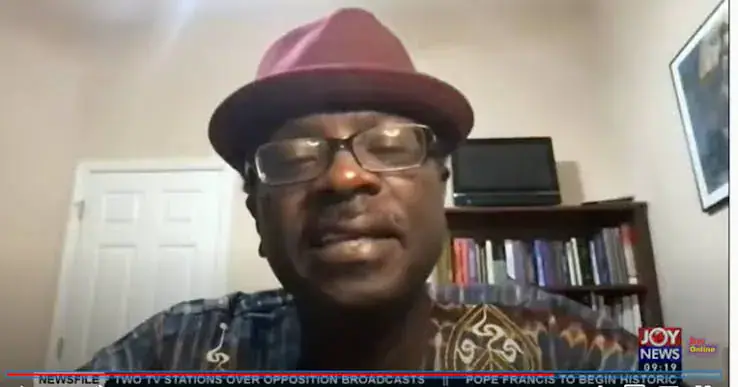
A prominent Ghanaian legal scholar, Kwaku Azar Asare, has raised questions about the legitimacy of the New Patriotic Party's (NPP) Supreme Court suit regarding presidential term limits. According to Asare, the NPP's filing appears to be a request for an advisory opinion, which falls outside the court's powers. This development has sparked debate about the court's role in interpreting constitutional provisions. Asare's concerns were reported by MyJoyOnline and have significant implications for Ghana's politics.
The NPP filed a suit with the Supreme Court on October 28, 2026, seeking to interpret Article 66(2) of the 1992 Constitution. The article sets a four-year presidential term and limits any individual to serving two terms in office. The party wants the court to clarify whether this two-term cap applies to consecutive or non-consecutive terms, which could impact President John Dramani Mahama's eligibility to contest the 2028 election. This question has significant implications for Ghana's presidential succession.
Asare's core objection lies in the difference between a genuine legal dispute and an abstract disagreement over constitutional interpretation. He cited past NPP cases, including the 31st December case and a challenge over police permit requirements for demonstrations, as examples of legitimate legal disputes. In contrast, the current suit does not identify any unconstitutional law, act, or omission, according to Asare. Instead, it appears to be a public debate over constitutional interpretation.
Asare referenced the 1993-94 case of Bilson v Attorney-General, in which the Supreme Court established that it has jurisdiction to interpret constitutional provisions within the context of real disputes, but not to offer advisory opinions. He also cited Ex parte Akosah, cautioning against reading it as an open invitation for citizens to manufacture competing interpretations and demand the court settle them. Asare emphasized that the Supreme Court is a court of law, not a constitutional advice centre.
The NPP's suit has significant implications for Ghana's politics, particularly regarding President Mahama's potential candidacy in the 2028 election. Asare's concerns have sparked debate about the court's role in interpreting constitutional provisions and the legitimacy of the NPP's suit. The Supreme Court's decision will have far-reaching consequences for Ghana's democracy and the interpretation of its constitution.
Asare urged the court to resist taking up every constitutionally flavoured question simply because it is politically charged or publicly interesting. He emphasized that disagreements among lawyers, academics, and political parties over constitutional meaning are a normal part of public discourse, but do not necessarily create a case for the Supreme Court to hear. The court's response to Asare's concerns will be closely watched by Ghanaian citizens and the international community.
The outcome of the NPP's suit will have significant implications for Ghana's democracy and the rule of law. The Supreme Court's decision will determine whether the NPP's suit is a legitimate constitutional dispute or an attempt to seek an advisory opinion. The court's ruling will also impact the country's presidential succession and the interpretation of its constitution. Key stakeholders will be watching closely as the case unfolds.
Key points
- The NPP's suit seeks to clarify whether the two-term cap on presidential terms applies to consecutive or non-consecutive terms.
- Asare argues that the NPP's filing appears to be a request for an advisory opinion, which falls outside the court's powers.
- The Supreme Court's decision will have significant implications for Ghana's democracy, the rule of law, and the interpretation of its constitution.